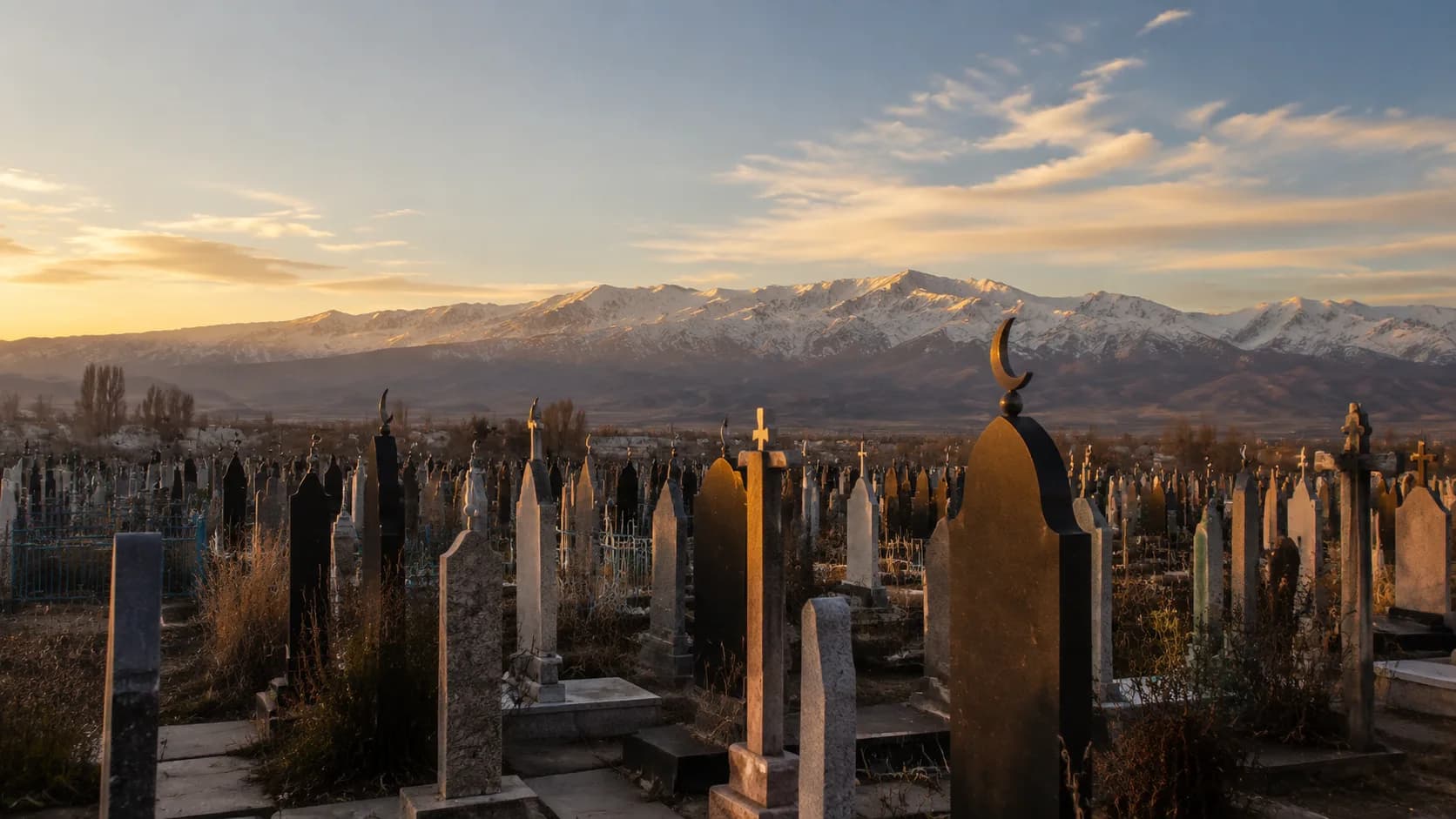
In Uzbekistan, a single cemetery often holds Muslim, Orthodox, Bukharian Jewish, Armenian and Polish Catholic sections side by side. Such a density of traditions on one piece of land is rare in the modern world. Each community has its own rhythm of mourning, its own dates, its own memorial foods, its own way of holding memory. This article is a map — not a substitute for the deep-dive spokes (linked below), but an orientation.
Muslim tradition is dominant in Uzbekistan. Burial happens within 24 hours, in the grave without a casket or in a simple coffin, with men accompanying the body to the cemetery. The key memorial days are 7, 20, 40 and a year; on the 40th day and the anniversary, families host an «ehson» — a meal of plov accompanied by Quran recitation. Monuments and fence work are typically commissioned after the 40th day.
Uzbek national customs layer on top of Islam. Many Uzbek families add «sadaqa» (charitable distribution of food and clothes), the memorial «marosim» gathering and the special anniversary plov on top of the strictly Islamic canon. None of this contradicts Sharia, but the form and volume vary by family and region.
Orthodox Christian commemoration falls on day 3, 9, 40 and annually. Sorokoust is a 40-day prayer commemoration in church. Radonitsa, the only memorial day that lands on a Tuesday rather than a Saturday (the Tuesday after Easter Week), is the moment to visit the grave with kutya, uzvar and pies. Seven «parental Saturdays» punctuate the year, the most prominent being the Meatfare, Trinity and Demetrius Saturdays.
Bukharian Jewish mourning has shiva (7 days at home), shloshim (30 days), Hakamat HaMatzevah (the unveiling, usually within the first year), and the annual Yahrzeit by the Hebrew calendar. Families place a small stone on the headstone, not flowers, and visit during Elul before the High Holidays (Kever Avot).
Armenian Apostolic tradition observes 7, 40 and the anniversary; Hokehangist is the requiem service. The khachkar — an intricately carved cross-stone — is the characteristic grave marker. Red carnations and a single candle are the typical visit kit.
Polish Catholic tradition arrived with the 19th-century exiles and the Anders' Army; it survives mostly in Samarkand and Tashkent. The major commemoration is All Souls' Day on November 1 — many votive candles glow across the Catholic section that night, with white chrysanthemums on the stones.
Korean Koryo-saram families mark the Buddhist 49-day point as well as the death anniversary («Chesa»). A traditional offerings table — rice, fruits, fish, candles, incense — is arranged in a specific pattern. In the Uzbek diaspora, Koryo-saram practice has mixed with Russian Orthodox and secular customs, so many families honour both 40-day and 49-day milestones.