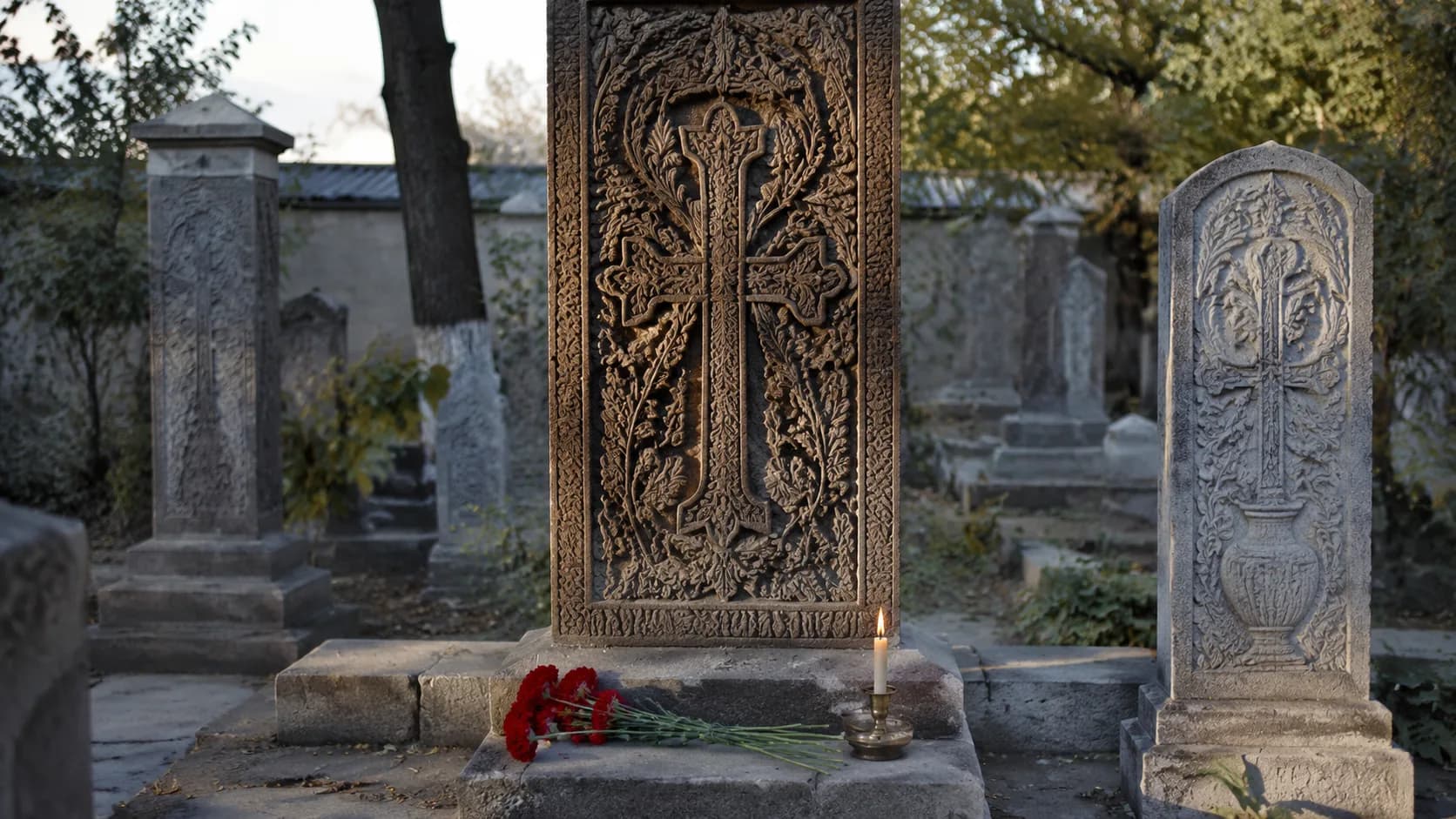
Armenians in Uzbekistan are a small but historically rooted community — part arrived in the 19th century, part fled the 1915 genocide. Tashkent has a distinct Armenian section on one of the older cemeteries; Samarkand has several family plots.
Burial usually happens on day 3. Hokehangist, the Armenian Apostolic requiem service, is the central liturgical form. Day 7, day 40 and the anniversary follow. The khachkar — a vertical stone with a carved cross surrounded by ornamental motifs — is the characteristic grave marker.
On the grave, Armenian families bring red carnations and a brass candle. On the anniversary, families may add cognac, fruit and home-made pastries.
We sync visits to the Armenian calendar — 7, 40 and the anniversary — and we know to bring red flowers and a brass candle on those visits.
Frequently asked questions
Yes, locally from Uzbek or Indian granite. Quality carving requires an experienced craftsman — we know 2–3 stone workshops in Tashkent and Samarkand that work with Armenian iconography.
Yes. The Armenian Apostolic church in Tashkent or Moscow accepts requests; the service proceeds without the family present in person, and video coverage can be arranged.