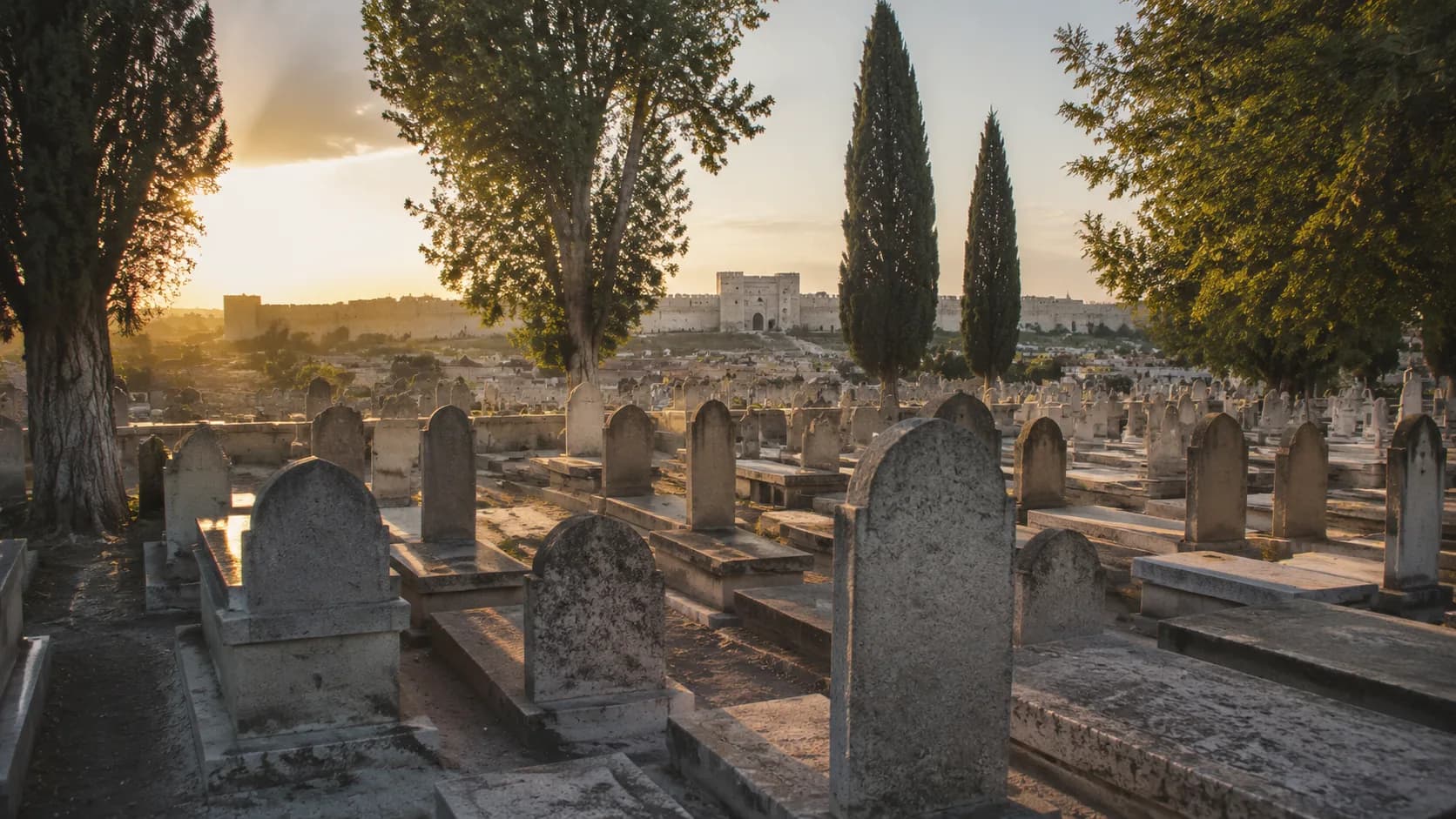
For 2,500 years a Jewish community lived in the cities along the Silk Road — in Bukhara, Samarkand, Tashkent, Kokand, Andijan, Margilan. Today around 50,000 Bukharian Jews live in Queens, New York; tens of thousands more in Israel and Vienna. In Bukhara itself, fewer than 100 community members remain. But the cemeteries, which hold the names and stories of those 2,500 years, are still there.
This guide is for the families abroad who want their parents' or grandparents' graves cared for — week after week, year after year — from the other side of the world. We start with the geography: which cemeteries hold the Bukharian Jewish community, and what makes each one different. Then we cover the diaspora practices that have grown up around remote care: the Bukhara Fund and similar diaspora organizations, the price benchmarks that have emerged from the Queens community, the verification practices that families use to trust contractors they will never meet. Finally we walk through how the lifecycle of Jewish mourning — Hakamat HaMatzevah, Yahrzeit, Kever Avot — can be observed faithfully even when no one in the family lives in Uzbekistan.
The five major Bukharian Jewish cemeteries — at a glance
Old Bukhara Jewish Cemetery — about 10,000 graves over roughly 80 acres at the western end of Ibrokhim Muminov Street, reachable by city buses 6, 33, 75, 76, 86 and 88 to the Yoshlar Markazi stop. This is the heart of the community: the oldest section dates back several centuries; the newer post-Soviet headstones, many of them paid for by relatives overseas, sit beside the worn stones of the rabbis and merchants of the medieval mahalla. The site is maintained beautifully — quiet, swept, with mature trees and a small ohel — primarily because of donations from the diaspora.
Tashkent "Textile" Jewish Cemetery — about 16,300 graves across 8 sectors, six of them Jewish and two Russian, located near the historic Textile factory in central Tashkent. This is where many of the Soviet-era families settled, and where Bukharian families who moved to the capital during the twentieth century are buried. The site is well-organized but more compact than Bukhara; many graves carry photo-ceramic portraits and bilingual Hebrew/Russian inscriptions.
Tashkent Botkin (Cemetery No. 1) — the imperial-era Russian cemetery founded in 1872, with a distinct Ashkenazi Jewish section concentrated in the 1930s–1940s, the period of Soviet repressions and the wartime evacuation of Jews from western Russia, Belarus and Ukraine to Central Asia. The Ashkenazi graves are clustered along Botkin Street and reachable by Tashkent city buses 1, 16, 18, 21, 30, 44, 80 and 96.