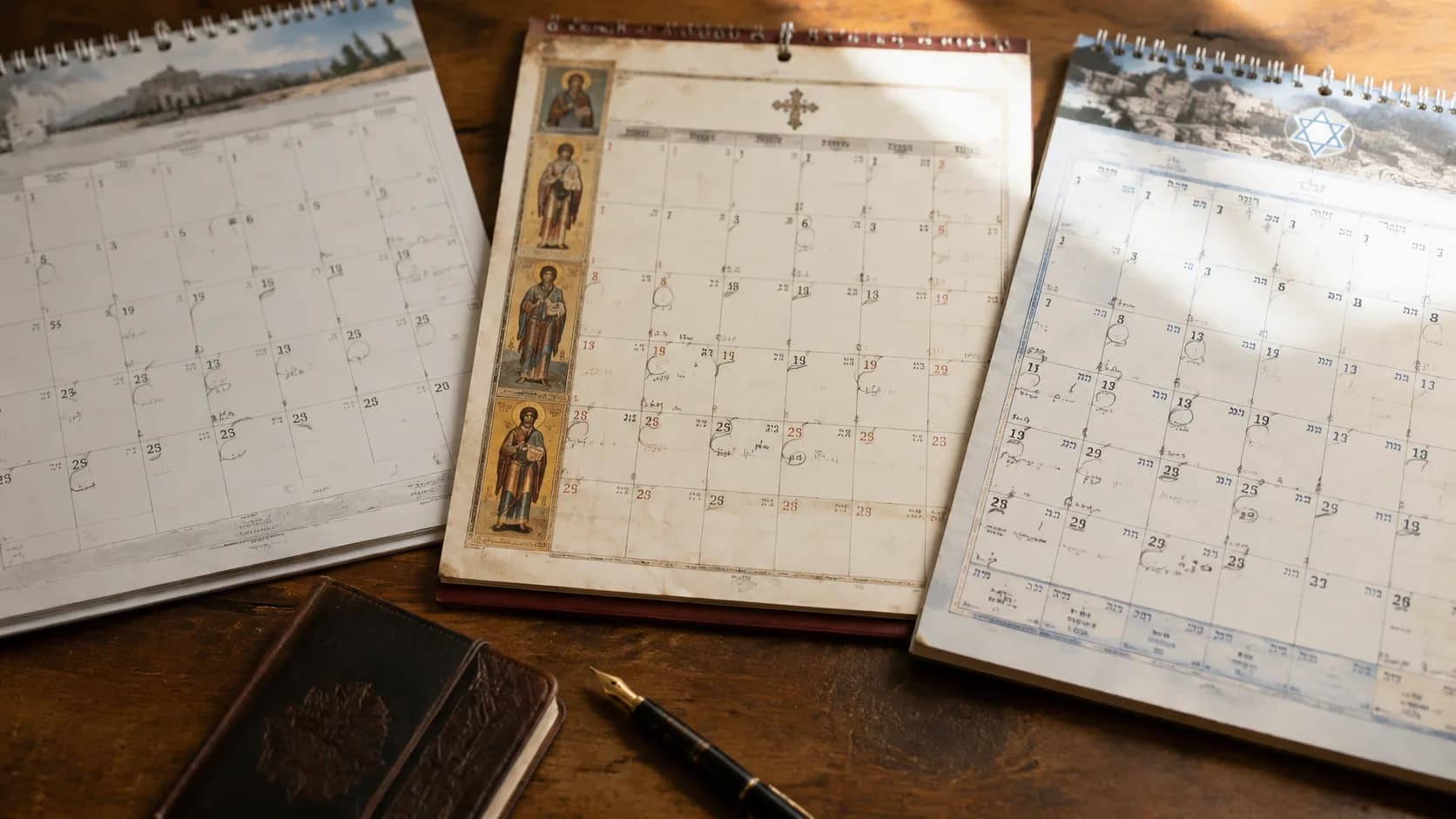
If you live in Queens with a Bukharian Jewish grandmother and a Russian Orthodox grandfather buried in two cemeteries in Uzbekistan, your annual memorial schedule has to span three calendar systems at once: civil (Gregorian), Hebrew, and Orthodox church (which uses the Julian calendar in some Slavic traditions). This pillar article is the practical guide to compressing all of those into one family schedule that doesn't slip dates.
The three (sometimes four) calendars at play. Civil Gregorian — universal, but most religious dates don't natively map to it. Hebrew — used for Yahrzeit, Bukharian Jewish observances, all Jewish holidays. Julian (used by Russian Orthodox Church) — Easter and the parental Saturdays are computed on Julian; they're about 13 days behind the civil calendar. Hijri — used for Muslim 7/20/40-day cycles and the anniversary; lunar, drifts about 11 days against the civil year. Armenian — Apostolic Church uses a hybrid; some saint days are Gregorian, others Julian.
Why this matters for a diaspora family. The Hebrew date of death stays fixed; the civil date shifts by 11–12 days each year. If you only remember Grandpa died «around February», by year 8 the actual yahrzeit could fall in mid-January or early March. Muslim anniversary drifts even faster (Hijri year is shorter than civil). Without active calendar mapping, you miss dates.
Tools that work. Hebcal.com — free, gives you the Hebrew-civil conversion for any year, with yahrzeit auto-projection 25 years forward. Islamic Finder — same for Hijri-civil conversion. Orthodox church calendars (online via the Russian Orthodox Church or the Patriarchate of Constantinople) cover the parental Saturdays and Radonitsa. We aggregate all of these into one calendar view in your grave.uz cabinet.
How our cabinet handles it. When you register a deceased relative, you enter the Hebrew, Hijri or church-calendar date of death along with the civil date. Our system auto-projects 25 years of upcoming observances — yahrzeit, parental Saturdays, 7/20/40-day cycles for Muslim, 3/9/40/anniversary for Orthodox, Armenian 40-day and anniversary. All in one timeline view.
The single-family-schedule approach. Combine all the observances for everyone on your file (mother, father, grandparents, in-laws) into one consolidated calendar. Block the date in your Google or Apple calendar 7 days before each observance so you have time to prepare (light a candle, schedule the cemetery visit, host the meal).