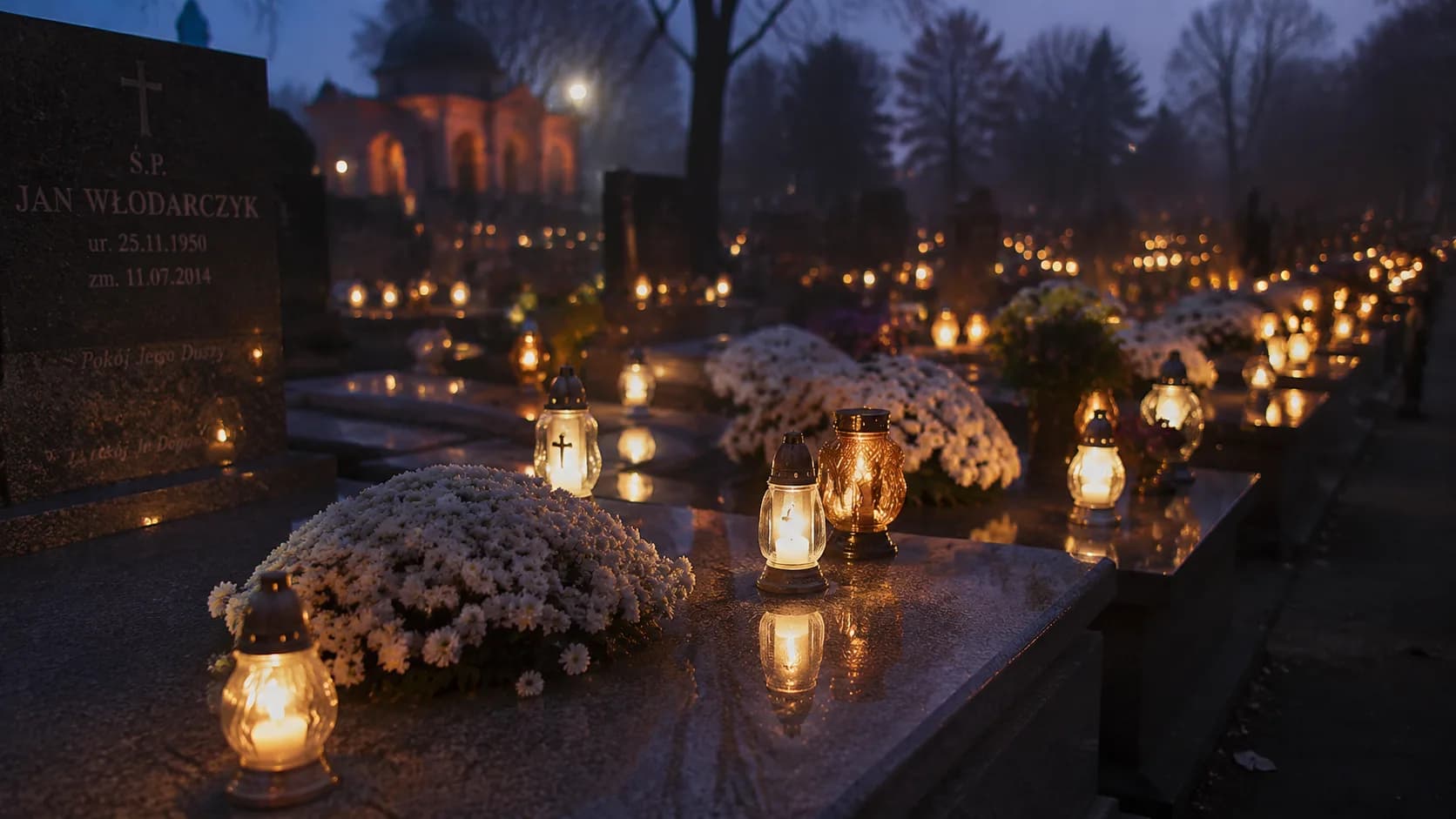
The Polish community in Uzbekistan dates to 19th-century Russian Empire exiles and the wartime Anders' Army evacuees. The Polish cemetery in Samarkand is one of the most moving sites of Polish diaspora memory in Central Asia.
Burial on day 3, with a requiem mass. Days 9 and 40 each have their own mass. The central memorial day is November 1, All Saints' Day (Wszystkich Świętych), when families bring many votive candles (znicze) and white chrysanthemums; by dusk the Polish section becomes a sea of small lights. November 2 is All Souls' Day (Dzień Zaduszny), with a requiem mass for all the departed.
On the grave: white chrysanthemums, votive candle lanterns, a simple wooden or granite cross. Care of the plot from the diaspora is usually 3–4 visits a year — November 1, the anniversary, and the deceased's name day or birthday.
We sync the visit schedule to the Catholic calendar — 9, 40, the anniversary, and the November 1 cluster — and we light votive candles and bring white chrysanthemums on the right dates.
Frequently asked questions
From 3–5 per family plot up to several dozen for a fuller display. We place candles according to the rules of the particular cemetery and as agreed with you; there is no separate candle package. For 1–2 November the Memorial visit with flowers or the Memorial visit with flowers and video fits. The price is on request: Samarkand has a regional coefficient, and we confirm the exact amount before payment.
The main one is the Polish cemetery in Samarkand. Tashkent has Catholic sections in several city cemeteries; smaller plots exist in Andijan and Fergana.
Read next in this cluster
- Armenian, Muslim and Jewish funerals in UzbekistanA respectful overview of how Uzbekistan's communities — Muslim, Orthodox, Bukharian Jewish, Armenian, Catholic, Korean, and secular — say goodbye and commemorate their dead.
- Orthodox commemoration: Sorokoust, parental Saturdays, RadonitsaHow Russian Orthodox families commemorate their dead: day 3, 9 and 40 after death, the 40-day Sorokoust prayer, seven parental Saturdays a year and Radonitsa after Easter.
Related topics
Need help or a detailed estimate?
We're available 24/7. Leave a request — we'll call back and clarify.