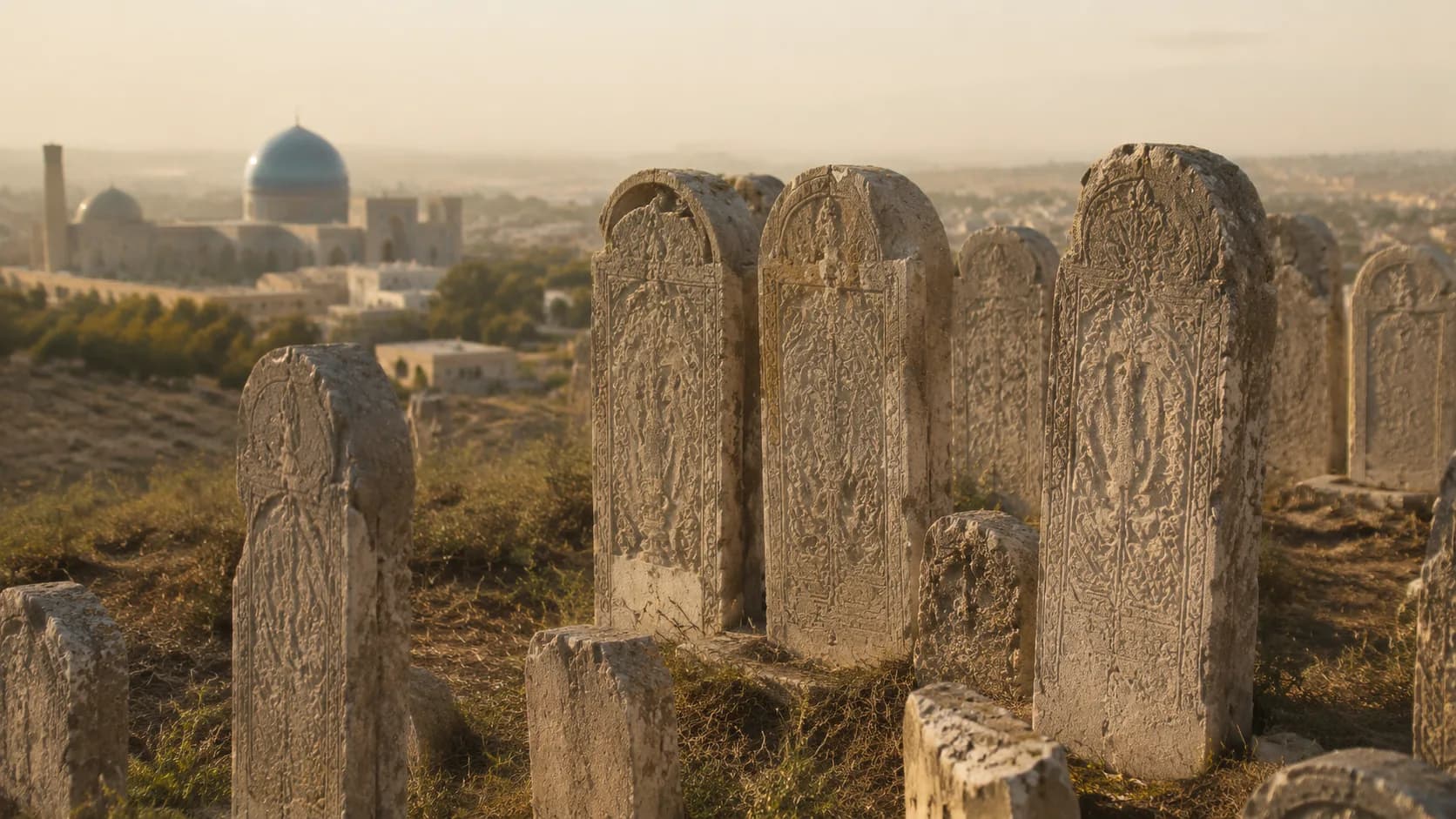
Samarkand was once a major centre of Bukharian Jewish learning, and the cemetery reflects that heritage. The Samarkand Old Jewish Cemetery sits adjacent to the historic Mahalla Yahudi (Jewish quarter) at the foot of Hojum Hill. It is smaller than the Bukhara cemetery (a few thousand graves) but houses some of the most historically significant Bukharian rabbinic family plots.
Notable family plots. Several rabbinic dynasties have continuous plots here going back 6–8 generations — the Aminov, Kandinov, Mullokandov and other major lineages. These families are still in active diaspora in Israel and the US, and they actively maintain their ancestral plots from afar.
Style and condition. Bukharian style: dark granite with bilingual Hebrew + Russian inscriptions, ceramic photo-plates on most post-1960 stones. Pre-Soviet stones are typically white limestone with deeply carved Hebrew text only. Condition: well-maintained, mostly thanks to private family upkeep rather than a Bukhara‑Fund-style organization. The site is gated and watched.
Access. The cemetery is at the western edge of the old Jewish quarter, about 800m from the Registan ensemble. Walking from Registan: head west along Tashkent Street, then turn south at Magoki Yahudiyon mosque area. Open daily; gatekeeper present 8:00–18:00.
Visiting protocol. Same as the other Bukharian cemeteries: men cover heads, women welcome, place stones on the matzevah. The cemetery is more touristic than Bukhara's — tour groups occasionally visit — so timing your remote service to early morning or late afternoon is calmer.
What we do in Samarkand. Standard search packages, Yahrzeit visits, monument restoration (we know two excellent stonemasons in Samarkand for pre-1960 restoration), Hakamat HaMatzevah with the Samarkand rabbi.
Frequently asked questions
A small community remains, primarily elderly, with one functioning synagogue near the old quarter. Most ritual coordination for the cemetery goes through Tashkent or the diaspora.