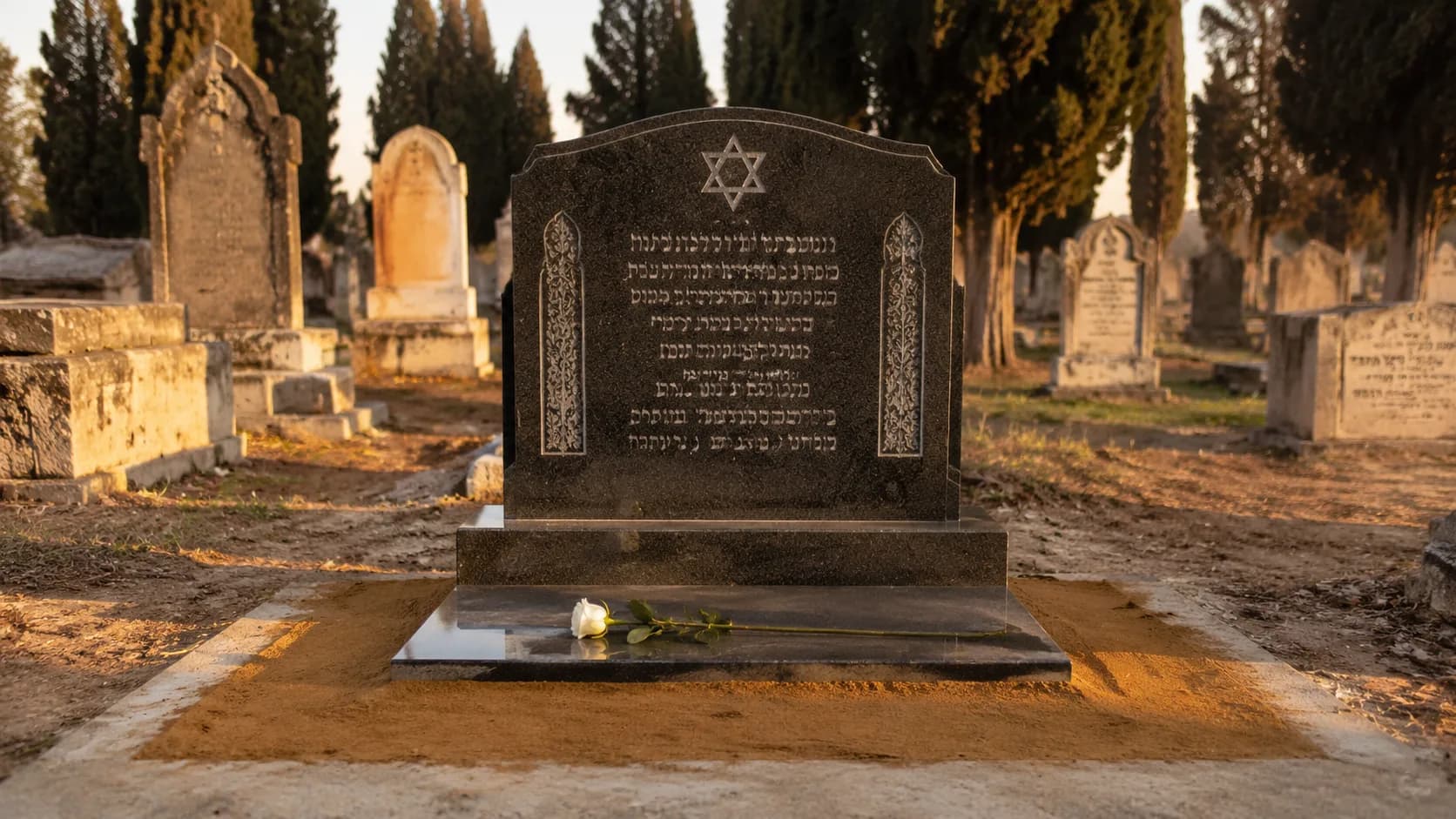
Hakamat HaMatzevah — literally «erecting the stone» — is the formal placement and unveiling of the headstone over a Jewish grave. The Bukharian community observes this within the first year, typically around the eleventh month after burial, between the end of shloshim and the upcoming yahrzeit. The ceremony has both halakhic and emotional weight: it marks the formal completion of the active mourning period.
Timing in the Bukharian custom. Ashkenazi tradition typically waits a full year; the broader Sephardic and Bukharian custom unveils around the 11th month. The exact date is set by the family rabbi based on the Hebrew calendar and the family's circumstances. For diaspora families, we coordinate the date with you 60–90 days in advance so the stone work, the trip (if anyone is travelling), and the local minyan can all be aligned.
Material and inscription. Black or dark grey polished granite is the prevailing material in Bukharian-community cemeteries today — durable in the Uzbek climate, easy to read. The inscription is bilingual: Hebrew on the upper portion (deceased's Hebrew name, dates by the Hebrew calendar, the formulaic «תנצב"ה»), Russian below (civil name and dates). Some families add a brief epitaph in Russian or English.
Stonework in Uzbekistan. Three or four workshops in Tashkent and Bukhara specialize in Bukharian Jewish matzevot. Lead time from order to install is typically 4–6 weeks: 2–3 weeks of stone work + 1 week of polish and engraving + 1 week of installation including foundation drying. Our standard offering is the Indian granite Absolute Black with laser-engraved Hebrew lettering and a small Star of David element at the top.
The unveiling ceremony itself. In the Bukharian custom: a small minyan of 10 men, a brief reading of Tehillim, the removal of the cloth covering the matzevah, Kel Maleh Rachamim prayer for the deceased, optional Kaddish recited by the son. Total duration 25–40 minutes. If no family member is present, we coordinate with the local Tashkent or Bukhara Chevra Kadisha to provide the minyan and the rabbi.
Video for the diaspora. Most diaspora families participate remotely. We provide a high-quality video stream of the ceremony (HD, with audio), recorded for archive, viewable live by the family in any time zone. Cost included in our standard Hakamat HaMatzevah package.
Cost. The matzevah (Indian Absolute Black granite, standard size 100×60×8 cm + base) and its installation are priced on request — the coordinator fixes the estimate after photos and sizes. The ceremony coordination and a full Hakamat HaMatzevah with video are quoted the same way. Compared to equivalent stones in the US ($8000–15000) or Israel ($5000–10000), ordering in Uzbekistan is a significant saving.
Frequently asked questions
Yes. We coordinate with the local Chevra Kadisha and a rabbi to provide the minyan and conduct the ceremony, with HD video for the family to watch live or recorded.
Sephardic and Bukharian halakhic tradition follows the principle that the active mourning period concludes once the matzevah is in place — placing it within the year (not at the year's end) gives the family a clear ritual closure point before the yahrzeit.
Read next in this cluster
- Bukharian Jewish Cemeteries in Uzbekistan: a Diaspora's GuideWhere the Bukharian community's ancestors rest — Bukhara, Tashkent, Samarkand and beyond — and how families abroad keep their graves cared for from across the world.
- Yahrzeit observance from the diaspora: organizing from Queens, Tel Aviv, BerlinHow a diaspora family lights the yahrzeit candle in New York while we visit the grave in Tashkent, recite Tehillim, and send back photo and video on the same Hebrew date.
- Kever Avot: visiting parents' graves in Uzbekistan remotely during ElulThe Sephardic and Bukharian tradition of visiting ancestral graves before the High Holidays, adapted for the diaspora — how a representative visits, recites Tehillim, and the family watches by video.
Related topics
Need help or a detailed estimate?
We're available 24/7. Leave a request — we'll call back and clarify.