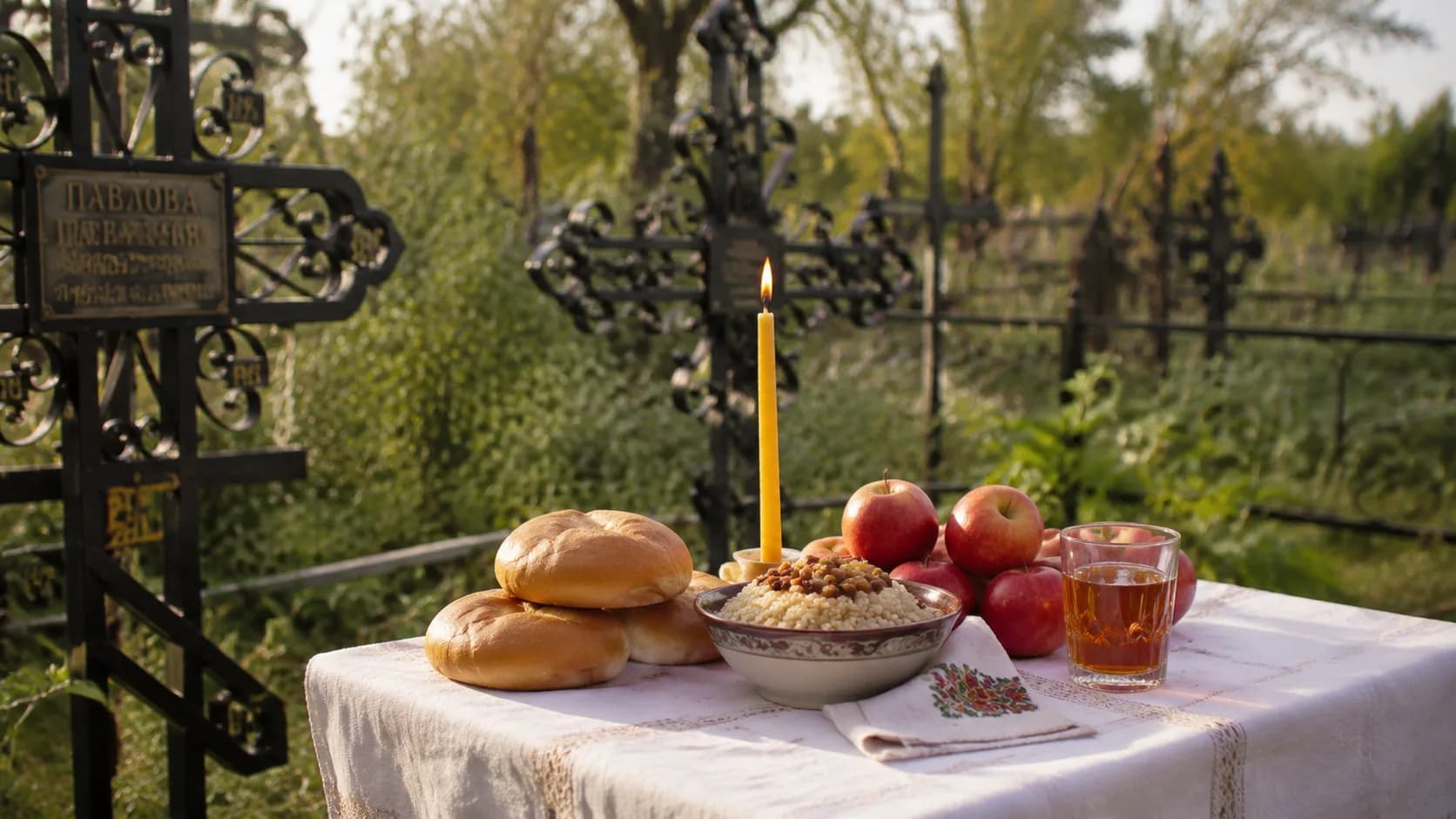
The ninth day after death is one of the main memorial dates in the Orthodox tradition, together with the third and the fortieth. On this day the family prays for the deceased in church, visits the grave and gathers close people for a memorial meal. Here is how to count the date, what is customary and how to mark it if you are far from Uzbekistan.
What the ninth day means
According to church tradition, in the first days after death the soul is still bound to the earthly world; it is then shown the dwellings of paradise, and after the ninth day begins the path to the fortieth. The number nine is linked to the nine orders of angels, who are asked to intercede for the deceased.
How to count the date
The day of death counts as day one, even if the person died late in the evening. If death came on the 1st, the ninth day is the 9th, not the 10th. The forty days are counted the same way. If the ninth day falls on a weekday, the prayer in church is ordered for the date itself, and the family meal is often moved to the nearest weekend.
Remembrance in church
A note “for the repose” is submitted for the liturgy and a panikhida (memorial service) is ordered. In Tashkent this can be done at the Holy Dormition Cathedral and other Orthodox churches of the city. For the forty days many families order a sorokoust.
The memorial meal
By custom nobody is specially invited on the ninth day: those who remember the person and want to support the family simply come. The meal starts with a prayer and kutia, boiled rice or wheat with honey and raisins, followed by soup, pancakes, porridge, fish or meat, and kissel or compote. By church tradition no alcohol is served: it is a remembrance, not a feast.
At the cemetery
On this day the family visits the grave: clears litter, brings fresh flowers, lights a lamp and prays. Funeral wreaths are usually left until the fortieth day.
And among Muslims
Muslims in Uzbekistan do not mark the ninth day; their memorial days are the 3rd, 7th, 20th and 40th day and the anniversary. See our Muslim memorial calendar.
If you live far away
A note can be handed to the church through relatives in Tashkent, and many parishes accept commemorations by phone. If nobody on the ground can visit the grave, we will do it by the date: tidy it, bring flowers, light a lamp and send photos and video with a GPS pin.
Frequently asked questions
The day of death is day one. If the person died on the 1st, the ninth day is the 9th.
The church prayer is ordered for the date itself; the family meal can be moved to the nearest weekend.
By custom nobody is specially invited; those who remember the person come. Inviting the closest family is of course fine.
No. Muslims in Uzbekistan mark the 3rd, 7th, 20th and 40th days and the anniversary.
Read next in this cluster
- Mapping religious calendars to a single family memorial scheduleHow a multi-faith or interfaith family — Orthodox, Muslim, Jewish, Catholic — keeps every important memorial date in one synchronized schedule across the diaspora.
- 40 days after death: how it's observed in UzbekistanWhat is done on day 40 in different traditions, how to prepare and which services we provide in advance.
- Sorokoust: what it is and how to order from abroadWhat sorokoust is in the Orthodox tradition, why it's ordered for the 40 days after death, and how to arrange it from the US, Germany or Israel.
Related topics
Need help or a detailed estimate?
We're available 24/7. Leave a request — we'll call back and clarify.