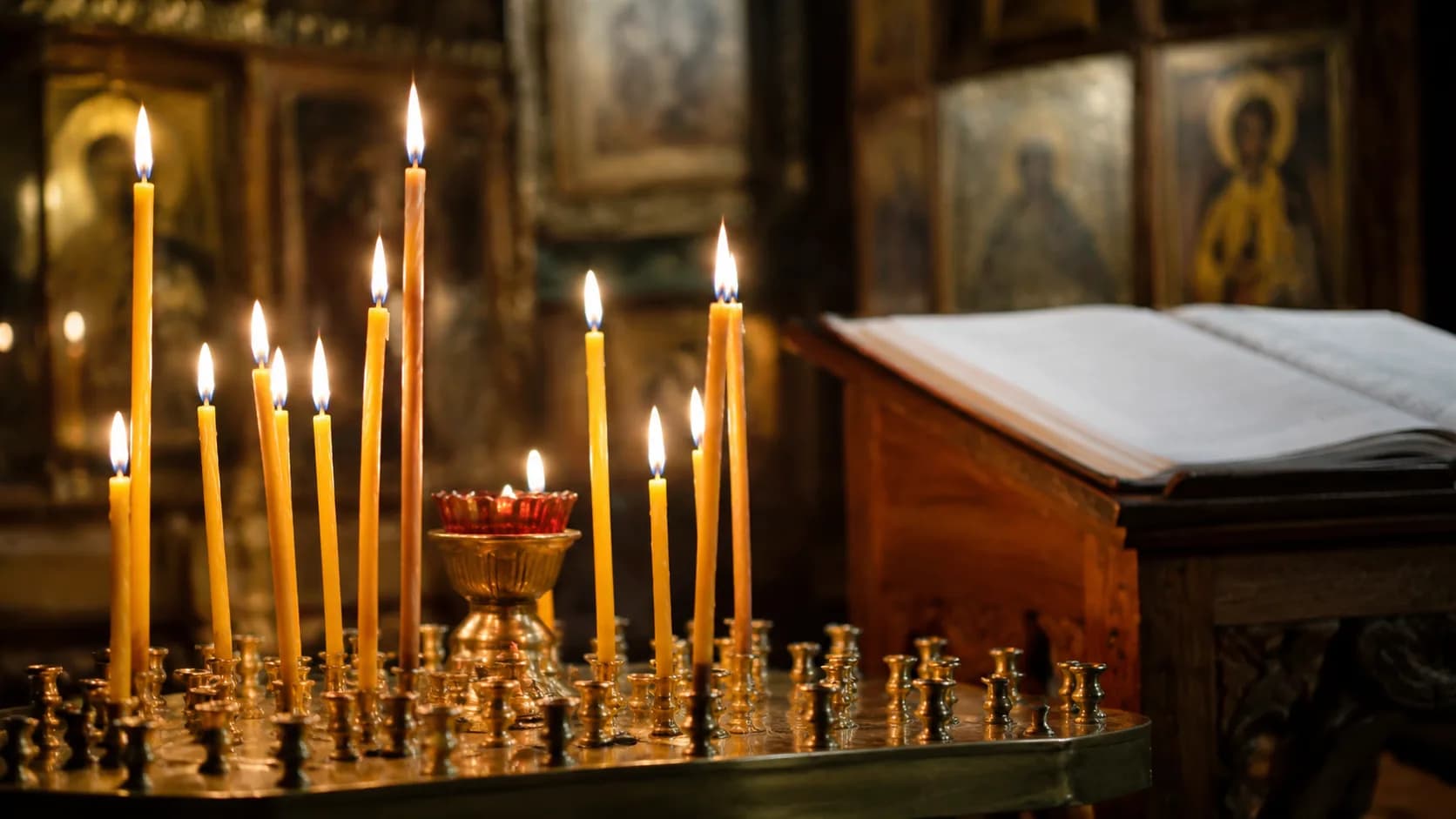
Sorokoust is a 40-day prayer commemoration of the deceased in church — one of the main forms of Orthodox remembrance. The word comes from Greek «τεσσαρακοστή» (40-day). For 40 days after death, each morning during the Liturgy, the priest takes a particle from the prosphora bread for the soul of the deceased and reads their name from the diptych.
Why 40 days specifically. Orthodox teaching holds that in the first 40 days the soul passes through testings (mytarstva) and completes its earthly path. On the 40th day its preliminary place is determined — a private fate until the General Judgement. The Church's prayer during this period is considered especially effective.
How to order. Visit any Orthodox church — parochial or monastery — and submit the name for sorokoust. The cost is symbolic ($5–15 in foreign parishes). The name must be in baptized form; non-baptized may be refused.
From abroad. Three options. (1) Online through many diocesan websites and major parishes. (2) Via relatives in Russia or Uzbekistan. (3) Through us — we coordinate with three Orthodox churches in Tashkent and one in Samarkand; included in our «40-day» package.
Sorokoust vs panikhida. Sorokoust is 40 consecutive liturgies. Panikhida is a single requiem service (3rd, 9th, 40th day, anniversary, or any date), 20–40 minutes, one-time.
Can sorokoust be extended? Technically yes — multiple consecutive sorokousts add up to year-long «extended» commemoration (≈9 repetitions).
After the 40th day. Usually a panikhida at the church + grave visit + memorial meal (traditionally without alcohol). Then annual commemoration on the anniversary, the deceased's birthday, and general parental Saturdays + Radonitsa.
Frequently asked questions
The idea is similar — 40-day prayer remembrance — but the form differs. Catholic equivalent: Gregorian Masses (40 consecutive masses). Armenian: a repeating form of the panikhida. Ask your priest.
Usually no — the priest may decline. Alternative: private home prayer for relatives of any faith is permitted.