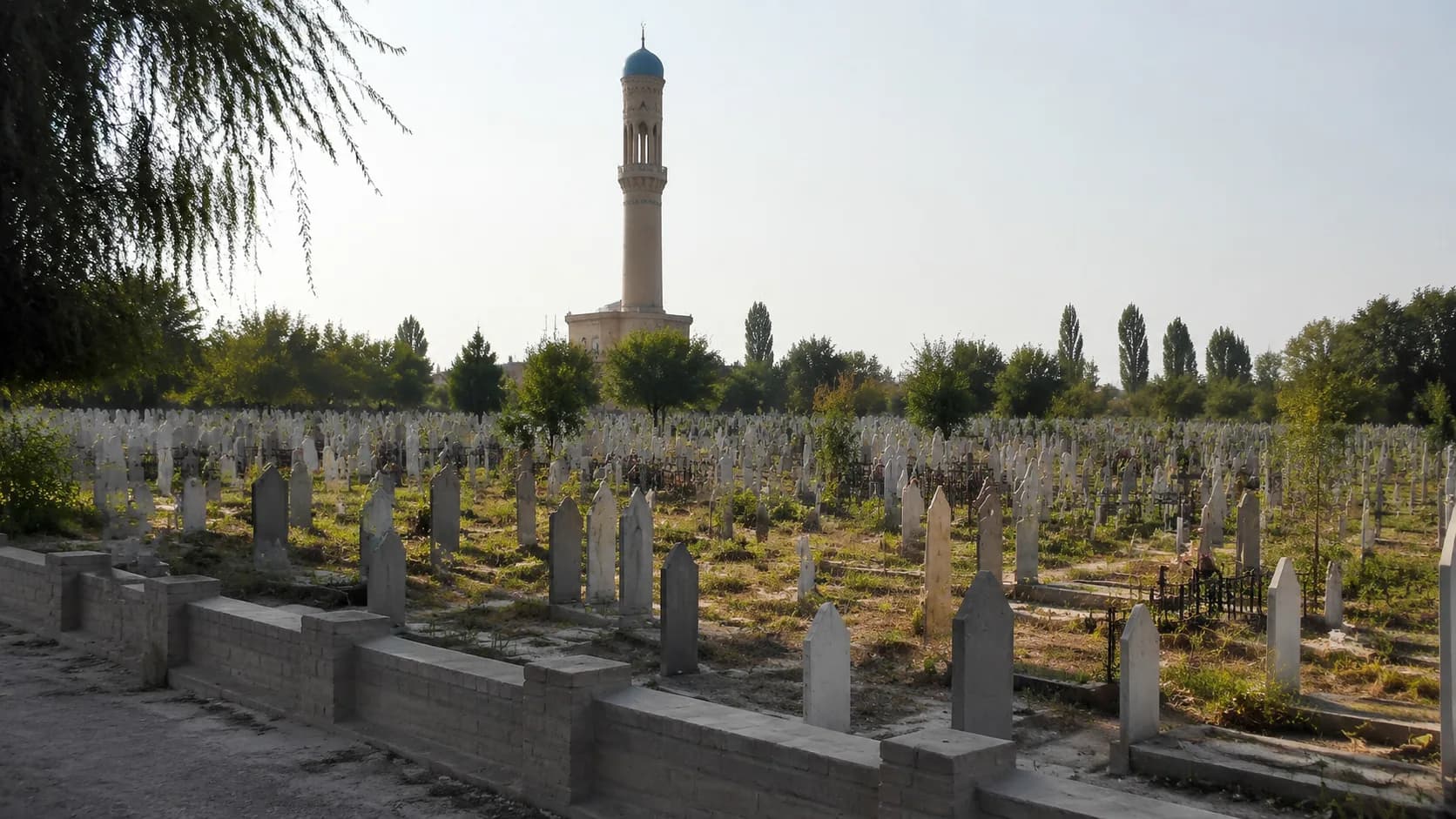
A cemetery is a place of silence and memory. There are few strict rules, and almost all of them come down to respect: for those buried here and for those who have come to visit their own. Below are the general rules, how the different traditions in Uzbekistan see it, and the well-known superstitions, marked as custom or as belief.
General rules for everyone
Speak quietly, do not laugh loudly or play music. Do not walk on graves or step over headstones; keep to the paths. Take nothing from other graves: the flowers, candles and photos belong to another family. Leave no litter: take wilted flowers, plastic and bottles with you or to the bin at the gate. Do not drink alcohol or smoke at the graves. Do not photograph other people’s graves or mourners without permission.
Muslim cemeteries
Most cemeteries in Uzbekistan are Muslim. On entering, people greet the dead: “Peace be upon you, people of these dwellings, the believers and the Muslims…”, as the Prophet taught. At the grave they recite Al-Fatiha or Surah Ya-Sin and make dua. Sitting on graves, leaning on headstones and eating on the graves are avoided. Dress modestly: shoulders and knees covered, women with a headscarf. By local custom men usually go to the burial itself, and women visit the graves of their relatives later; if in doubt, ask the imam of your mahalla.
Orthodox cemeteries
In Christian sections people cross themselves at the gate, light a candle at the grave and say a prayer. The Church does not approve of drinking at the grave or of leaving a glass of vodka and bread on the mound; that is a later folk habit, not a church rule. Food is better given to people in need. Flowers are brought in even numbers.
Jewish cemeteries
Instead of flowers, a small stone is placed on the headstone as a sign that the grave was visited. Men cover their heads. People do not eat at the cemetery and do not visit it on the Sabbath or on holidays. On leaving, they wash their hands.
Superstitions: what people believe and what is true
“Never go to a cemetery after sunset.” There is no religious ban, but there is a practical reason: many cemeteries close in the evening, there is almost no lighting, and it is easy to get lost or trip. Go in daylight.
“Do not look back when leaving” and “take nothing from a cemetery”. The first is a superstition. The second makes sense: out of respect you leave other people’s things alone, while your own wilted flowers and litter should be taken away.
“Pregnant women must not go to a cemetery.” Neither Islam nor the Orthodox Church forbids it. Families often advise pregnant women to skip funerals because of the strain; that is care for her health, not a ban, and the choice is hers.
“Do not tidy the grave in the first year.” A superstition. Litter and weeds can and should always be cleared. The only thing to wait for is the heavy headstone, until the soil settles; see when to put up a headstone after a funeral.
When people visit
Muslims in Uzbekistan visit on the 3rd, 7th, 20th and 40th day and on the anniversary (the memorial calendar), and on Ramadan and Kurban Hayit. Orthodox Christians visit on the 9th and 40th day, on the anniversary, on Radonitsa and on the parental Saturdays; by church tradition they do not go to the cemetery on Easter Day itself.
If you live far away
If you cannot visit yourself, we can do it for you: tidy the plot, wash the headstone, bring flowers for the date and send before-and-after photos with a GPS pin. See grave care when you live far away.
Frequently asked questions
Neither Islam nor Orthodox Christianity forbids it. Families sometimes advise against funerals because of the strain, but the decision is the woman’s own.
Visits are made in daylight. Many cemeteries close in the evening and are unlit, so check the opening hours with the cemetery office.
Your own family’s grave, yes. Photographing other graves or mourners without permission is not done.
Neither Islam nor the Church requires it. Food in memory of the deceased is better given to people in need, leaving only flowers on the grave.
Read next in this cluster
- Armenian, Muslim and Jewish funerals in UzbekistanA respectful overview of how Uzbekistan's communities — Muslim, Orthodox, Bukharian Jewish, Armenian, Catholic, Korean, and secular — say goodbye and commemorate their dead.
- Muslim funeral and memorial traditions in UzbekistanHow Muslim families in Uzbekistan perform funerals and memorial gatherings: janazah, same-day burial, ehson on day 7, 20, 40 and the anniversary.
- Orthodox commemoration: Sorokoust, parental Saturdays, RadonitsaHow Russian Orthodox families commemorate their dead: day 3, 9 and 40 after death, the 40-day Sorokoust prayer, seven parental Saturdays a year and Radonitsa after Easter.
Related topics
Need help or a detailed estimate?
We're available 24/7. Leave a request — we'll call back and clarify.