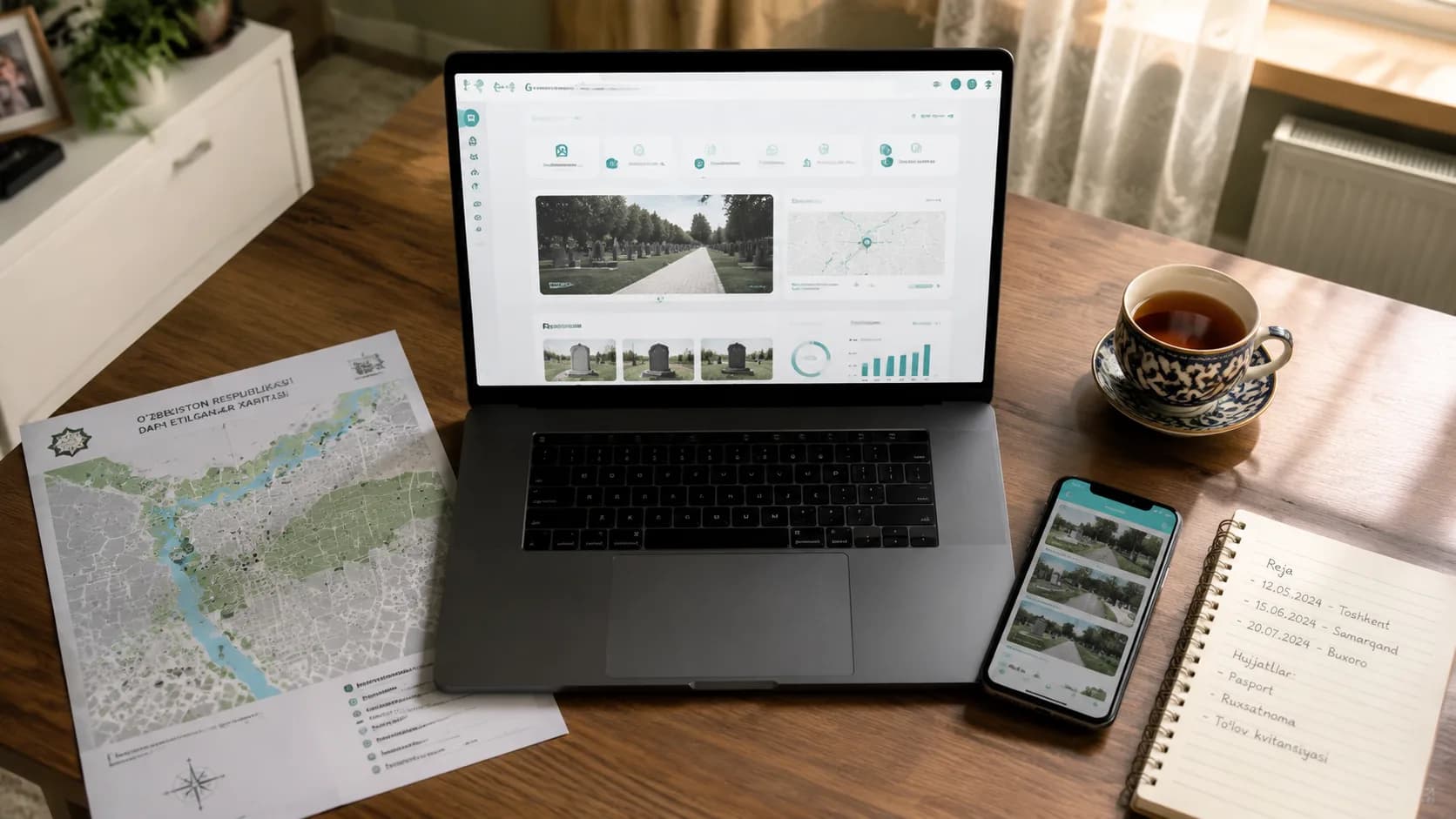
If you live in Moscow, Tel Aviv, Queens, Berlin, Toronto or Melbourne while your loved one's grave is in Uzbekistan, you face several practical tasks at once: find a contractor you can trust; tune the visit cadence to your family's calendar; pay from abroad without surprises; get confirmations the work happened. This article is the step-by-step.
Step 1: decide what you need. Four common formats — one-off (before a memorial date), seasonal (4 visits/year), regular (12–48 visits/year), or full-service turn-key (with minor repairs, scheduled flowers, quarterly video). Most diaspora families converge on 12 visits/year — a balance between cost and consistency.
Step 2: gather plot data. Cemetery, sector, plot number if known. If unknown — we can help find it (see grave search). Note religion: it shapes care style (Islam dislikes floral excess; Orthodox expects regular arrangements; Jewish tradition places stones rather than flowers).
Step 3: choose a contractor. Criteria: a price named before work and fixed in the contract (not «we'll see on site»), photo/video reports after every visit, 24-hour message response, experience with diaspora in your country, a clear way to pay from abroad.
Step 4: schedule. At grave.uz this is in your personal cabinet — you see the year ahead, can shift dates around memorial anniversaries, can add or remove visits. Most clients set it once and tweak 1–2 times a year.
Step 5: payment. Subscriptions are paid a year in advance; paying several years at once saves 10% (2 years), 15% (3–4 years) or 20% (5 years). Payment goes by the details in your contract: Uzcard, Humo or a SWIFT bank transfer (from abroad, usually SWIFT in US dollars); any other method by agreement with the coordinator.
Step 6: reports. After each visit you get 3–8 photos with EXIF (date + GPS) and a short text report in your cabinet. Quarterly or memorial-date short video on request.
Step 7: involve family. Multiple family members can have guest cabinet access — parents, children, nephews — turning the report flow into a family ritual.
Step 8: plan multi-generationally. Grave care is a 20–50 year commitment. We have a dedicated article on multi-generational planning (handing over to the next generation, documentation, subscription vs ad-hoc).
What we don't do. We don't give religious advice or judge memorial form. We don't cross your family's tradition lines (no flowers if your tradition says so; no portraits on the monument if forbidden). We do quality work and confirm it.
Prices are on request: we name them in the site chat after a couple of questions and fix them in the contract. If you're unsure which package fits — leave a request via grave.uz/en/kontakty. The first consultation is free.
Frequently asked questions
12 visits/year (monthly) — the cost/consistency sweet spot, covering all major memorial dates across faiths.
Yes. Reports are available in Russian, English, Hebrew, German, Uzbek, Korean. The cabinet's default language sets the report language.
Guest access to the cabinet is free. Guests see photos and reports but can't change schedule or billing.
Yes, up to 6 months a year — no penalty. Past 6 months a recalculation is needed; notify the manager.
Topics in this guide
- Remote grave care in Uzbekistan from the USA: step-by-stepPractical guide for Bukharian, Russian-speaking, and broader Uzbek-American diaspora families: how to set up grave care in Uzbekistan from anywhere in the US.
- Grave care in Uzbekistan from Germany: how it worksPractical guide for Russlanddeutsche and Spätaussiedler in Germany: how to organize regular grave care in Uzbekistan in German or Russian.
- Paying for grave care from abroad: SWIFT, Uzcard, HumoHow to pay for grave care in Uzbekistan from the US, Canada, Israel, Germany, Russia: a SWIFT bank transfer or a Uzcard/Humo card, by the details in your contract. Why not Wise, Zelle or crypto; fees and prepayment.
- How to verify the authenticity of a grave-care photo reportWhat an honest photo report must contain: EXIF metadata, geotag, time marker. Signs of forgery and what to do with doubt.
- Time-zone-aware grave-care communication with UzbekistanHow to communicate with a grave-care contractor in Uzbekistan when you live in a different time zone: scheduling, expected response times, message channels.
- Subscription visit frequency: 4, 6, 12, 24 or 48 per year — how to chooseHow to pick visit frequency for grave care: scenarios by religion and budget. What each frequency actually covers.
- Annual grave-care subscription: choosing the right frequency for diaspora familiesHow diaspora families in the US, Canada and Israel choose between weekly, biweekly, monthly, quarterly subscriptions for grave care in Uzbekistan.
- Long-term grave-care planning: a 5–10 year budgetHow to plan grave care for years ahead: inflation, rising work costs, handing over to the next generation, multi-year contracts.
- Identity verification when ordering grave-care services onlineHow we know who the client is without KYC or passport scans, when a cemetery or notary does need documents, and how we protect your data.
Related topics
Need help or a detailed estimate?
We're available 24/7. Leave a request — we'll call back and clarify.