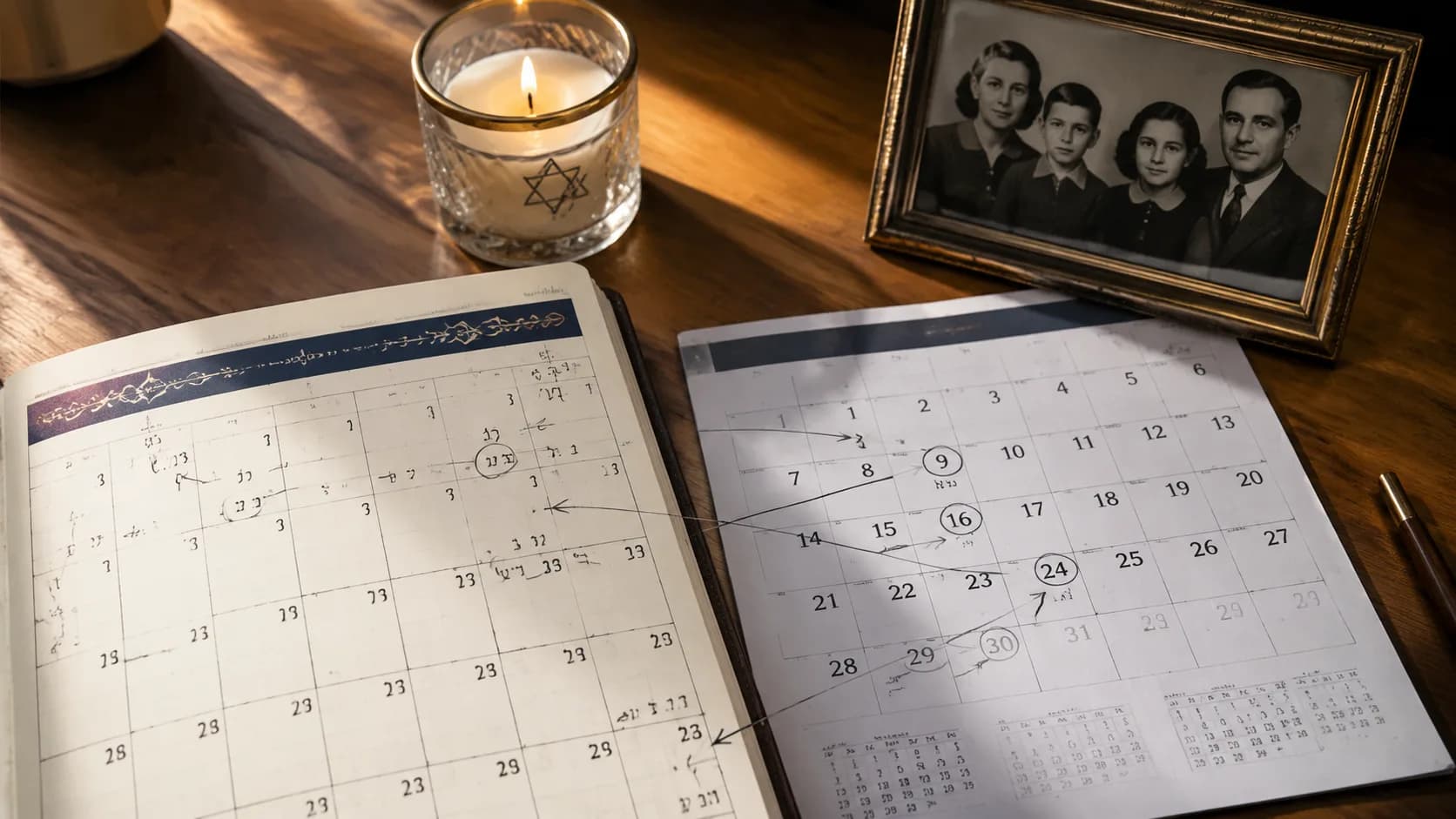
Most Bukharian Jewish families that left Uzbekistan for Russia in the 1990s grew accustomed to observing the death anniversary on the civil calendar — because Bukharian secular culture and the Soviet environment operated on Gregorian. When part of the family moves to Israel or Queens, a second calendar enters — the Hebrew yahrzeit, historically correct. This article covers how to combine them without stress.
Base case. Grandfather died March 12, 1995 in Samarkand. Hebrew date 10 Adar II 5755. Family in Moscow has observed March 12 for 30 years. Daughter in Queens wants the «correct» yahrzeit. Cousin in Tel Aviv already observes by Hebrew calendar. How to align?
Approach 1: observe both. The most honest and widely practiced. Light candles on both March 12 and 10 Adar II. If they fall close (about 60% of years), one is enough. If far apart — two separate events.
Approach 2: one as «family», the other as «personal». Family gathering on the civil date (because everyone remembers and can plan it); Hebrew yahrzeit as individual synagogue observance.
Approach 3: Hebrew only (the rabbinic recommendation). Halakhically, the Hebrew yahrzeit is the only correct day. The civil date is Soviet-cultural baggage, not religiously meaningful. Bukharian diaspora rabbis in Queens typically encourage the shift to yahrzeit. For religiously observant families, this is the natural move.
What grave.uz does. Enter both dates in the cabinet. We can schedule a visit on either or both. Mixed family: 2 visits/year. Religiously observant: only Hebrew. Secular: only civil.
When dates diverge sharply. Every few years the Hebrew date may be 4–5 weeks away from the civil date (especially leap years with Adar II). In those years, clarify with the family which date is «primary» that year. Record it in the family file; in 10 years no one will remember.
For families with mixed Christian-Jewish observances, the calendar gets harder. Use our cabinet's calendar module (see «Mapping religious calendars to a single family schedule»). One consolidated timeline with all family events.
Frequently asked questions
Generally yes, but gently — they present it as the «correct» option. They don't command; they explain that halakha is one, culture is another.