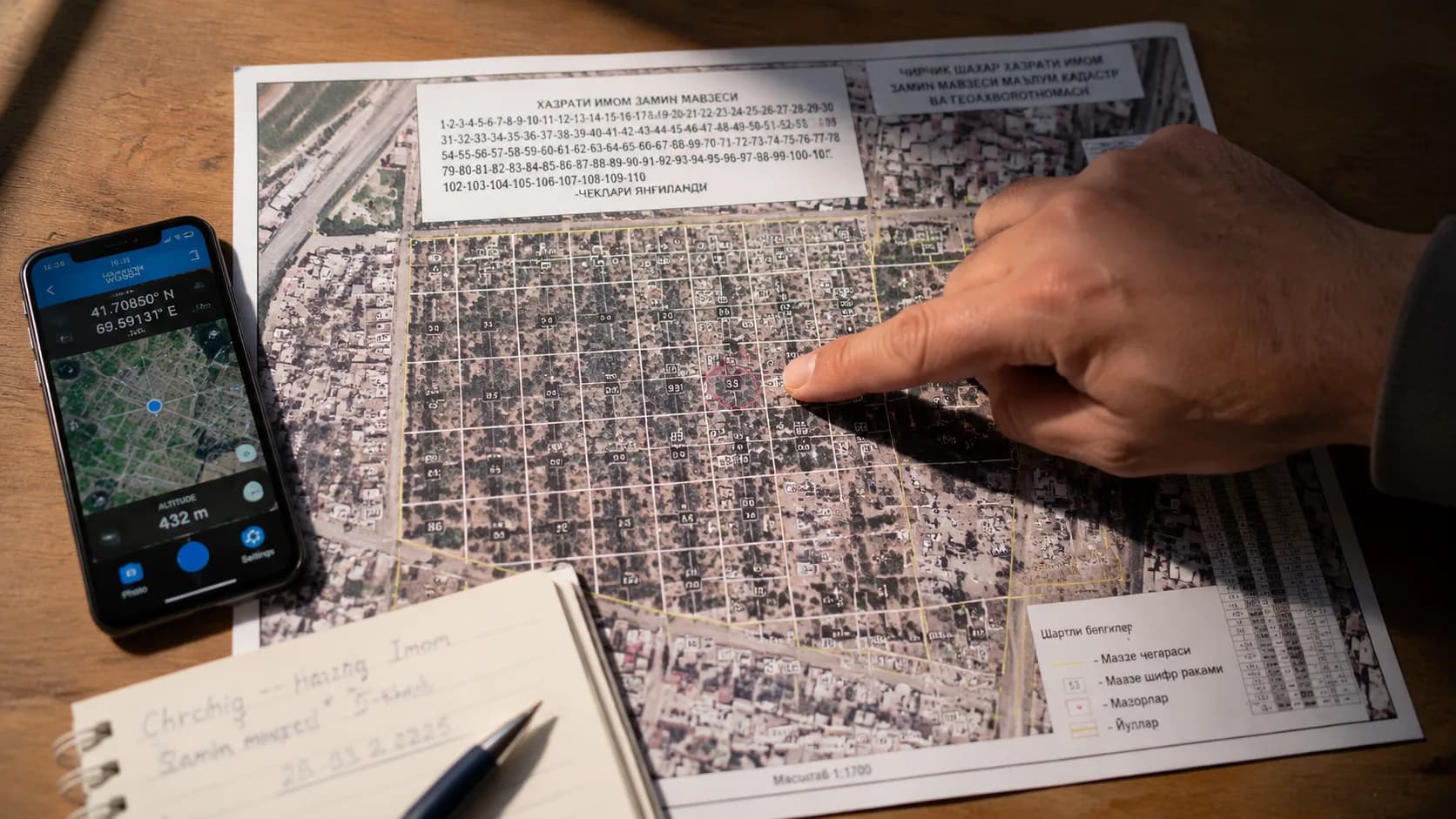
After the emigration waves of the 1990s and 2000s, many families lost precise records of where their relatives in Uzbekistan are buried. Cemetery archives changed hands, sections were renamed, paperwork was lost. This guide is a recovery roadmap — even when only a name and an approximate year survive.
Step 1: collect everything the family knows. Full name at the time of death (both surnames for women). Birth and death dates, even approximate. Last known city. Religion or ethnicity — this narrows the search dramatically because Muslim, Orthodox, Bukharian Jewish, Armenian, Polish and Korean cemeteries in Uzbekistan are mostly geographically separated. Spouse and children's names, profession.
Step 2: narrow down the cemetery. In Tashkent: Botkin (Cemetery #1) for deaths between 1872 and the 1960s; Domabad (Cemetery #2) for 1960s to present, 165 hectares and 450,000+ graves; Textile Jewish for Jewish families from the Soviet period (16,300 graves, 8 sectors). In Bukhara: the Old Jewish Cemetery for Bukharian families.
Step 3: request the cemetery archive. Each major Uzbek cemetery has an administration and a registration book. Requests typically take days to weeks and can be filed in Russian or Uzbek.
Step 4: when the cemetery archive is silent, ZAGS (civil registry) is the next stop. Uzbek ZAGS keeps death records; do not count on them naming the cemetery, but the date and place of death narrow the search — see how to find out which cemetery someone is buried in. Diaspora families can request copies via the consulate or online via my.gov.uz.
Step 5: online tools. Our grave.uz/en/poisk-mogil form filters by region and searches the cemetery database. For Jewish ancestors the IAJGS Cemetery Project is useful; for WWII and political repression victims, the OBD «Memorial» database.
Step 6: physical confirmation. Always order a photo or video confirmation once a candidate plot is found. A good confirmation includes wide-shot, close-up of the inscription, GPS coordinates and a walking route from the entrance.
Step 7: when it fails. Some searches don't succeed — graves get relocated, cemetery sections get reconstructed, family memory misplaces the city. Our articles on searching with incomplete data and photo verification cover the harder cases.
How the price is set. The price depends on what is known. Cemetery and plot known — a short on-site check. Cemetery known, plot unknown — a search of records and on foot. Cemetery unknown — we establish the cemetery first. Very little data or an old burial — longer, sometimes with archives. Remote regions cost more because of travel. The price is fixed per difficulty tier, A to E. We work under a contract: only stage 1 is paid up front (archives, credited to the price); the rest only if the grave is found, after the report. If it is not found, you pay nothing more. After a successful search the first grave cleaning is free. We name the exact price on request once we know your data: write to the site chat — a couple of answers is enough.
If you're diaspora — US, Canada, Israel, Germany, Russia — we handle different time zones, accept payment from any country, and communicate in your preferred language. Start at grave.uz/en/poisk-mogil or leave a request via grave.uz/en/kontakty for a fully accompanied search.
Frequently asked questions
That's almost always enough to start. An approximate year (a 5–10 year window) plus the city is a working starting point. The more precise the other data — full name, patronymic, relatives — the fewer candidates the search returns.
Online stage 2–5 days, site visit 3–10 days, archives from 2 weeks. Complex cases (sparse data, relocated burials) take longer; we can be more precise once we have reviewed your data.
We work under a contract: only stage 1 is paid up front (archives); the rest only if the grave is found, after the report. If the grave is not found, you pay nothing more — stage 1 covers the work already done. We quote stage 1 and the full price on request, once we know your data.
Yes. After your request we open a personal cabinet at grave.uz/en/kabinet with live status, attached documents, and a chat thread with the manager. Notifications go to email and Telegram if you connect it.
Topics in this guide
- Which cemetery? Finding a burial place in UzbekistanHow to find out which cemetery a relative is buried in, in Uzbekistan, when you only have a name and dates: mahalla, civil registry, registry, archives.
- How to find a grave in Uzbekistan from abroad: a diaspora's guideWhat US, Canadian, Israeli, German and Australian diaspora families need to know to find an ancestor's grave in Uzbekistan from across the world.
- Searching ZAGS and cemetery archives in UzbekistanHow to request a death certificate from the Uzbek ZAGS from abroad, how to query a major cemetery's archive, and which genealogical databases actually help.
- GPS coordinates of the grave and walking route from the cemetery entranceWhy precise GPS coordinates and a walking route from the entrance matter on a large cemetery, which tools we use, and how we share them with diaspora family.
- «Site located» video confirmation: how to order and what's includedA 30-60-second video pan over the plot, the name read aloud, a GPS stamp — for diaspora families and high-uncertainty cases.
- Searching for a grave with incomplete data: no patronymic, no exact dateWhat to do when only fragments remain: a name without a patronymic, an approximate year, a maiden name. The actual methods and success rates.
- Finding a relative's grave in Uzbekistan from Germany: a practical guidePractical guide for Russlanddeutsche and Aussiedler living in Germany: documents, language, how to reach an Uzbek cemetery archive.
- Verifying a grave from a photo: how to be sure it's the right oneA checklist for families: what a verification photo must include, how to read EXIF metadata, what to do with doubt.
- Searching graves of Soviet veterans and victims of political repression in UzbekistanA special class of search: WWII, the Labour Army, GULAG victims, deported peoples. Which databases and archives help, where to look in Uzbekistan.
- Finding a Bukharian Jewish ancestor's grave in Tashkent or BukharaHow Bukharian Jewish diaspora families in Queens, Israel and Vienna can search for an ancestor's grave in the major Uzbek Jewish cemeteries.
Related topics
Need help or a detailed estimate?
We're available 24/7. Leave a request — we'll call back and clarify.