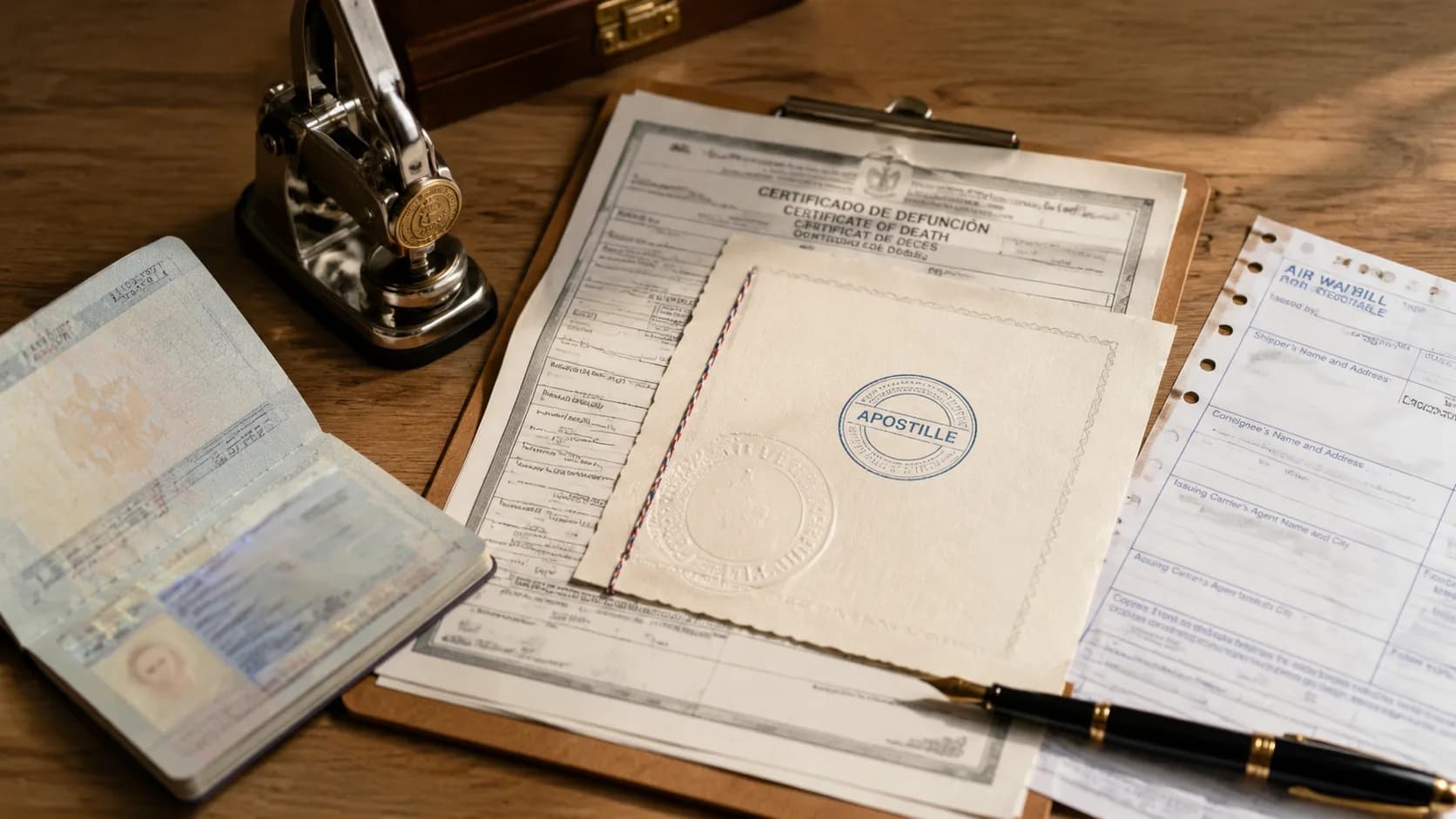
Repatriating a deceased relative across international borders is one of the most paperwork-heavy procedures in modern logistics. Every corridor — Uzbekistan to Russia, to Israel, to Germany, to the United States, to Canada, to anywhere — shares a core document stack. Local rules then add overlays. This pillar article walks through the universal stack; the corridor-specific spokes drill into the country overlays.
Document 1: the death certificate from the Uzbek ZAGS. This is the foundation document. Without it, nothing else proceeds. The ZAGS (civil registry) of the district where the death was registered issues it within 1–3 working days under normal conditions, longer if cause of death requires a medical examiner's report. The original is in Russian and Uzbek; for international use you need both a certified translation and an apostille (see next document).
Document 2: apostille on the death certificate. Uzbekistan joined the Hague Apostille Convention in 2012, which simplified this step dramatically. Before 2012 you needed full consular legalization, a process that could take months. Today the Ministry of Justice of Uzbekistan issues the apostille within 5–10 working days for around $30–50 in fees. The apostille makes the death certificate legally recognized in all 120+ Hague Convention countries.
Document 3: embalming certificate. Required by every airline carrying human remains internationally, regardless of the receiving country. Issued by the embalming facility (in Tashkent, several morgues are authorized). The certificate confirms that the body has been embalmed in a way that allows long-distance transport without health risk. Cost: $200–500 depending on facility.
Document 4: non-contagious disease certificate. Issued by the local sanitary-epidemiological station (SES). Confirms the cause of death was not contagious — a hard requirement for the airline. Standard turnaround 1–2 days, free of charge.
Document 5: consular legalization at the receiving country's consulate in Tashkent (or its Moscow embassy). What this looks like varies dramatically by country: the United States embassy issues a consular mortuary certificate; Israel works through the Chevra Kadisha and the Ministry of Foreign Affairs; Germany goes through the Konsulat with a Bestattungsschein follow-up. Each corridor spoke walks through its specific process.
Document 6: airline transit documentation. The airline that will fly the remains needs its own paperwork — a cargo waybill, certification of the hermetic zinc-lined coffin, an escort agreement if a representative will travel on the same plane. Most major carriers (Lufthansa Cargo, Turkish Airlines Cargo, Aeroflot Cargo, El Al Cargo) have dedicated human-remains handling teams.