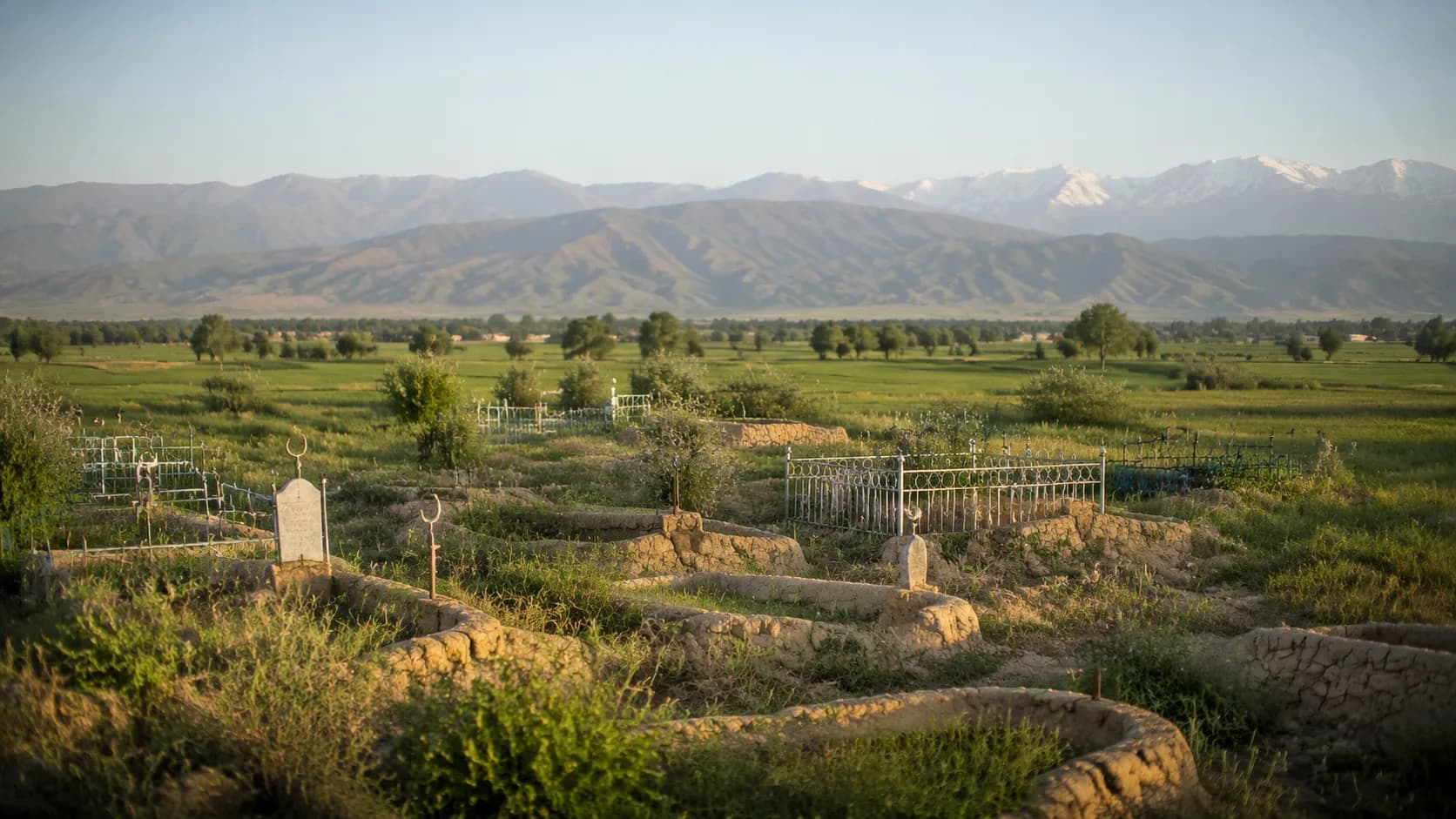
On 15 September 2026 the hokim (governor) of Tashkent region signed decision No. 374-10-0-Q/26 to relocate seven cemeteries that lie on the construction site of the New Tashkent international airport in the Kuyichirchik and Urtachirchik districts (decision text on e-qaror.gov.uz). If a relative of yours is buried there, below is what was decided, where the graves are going and what your family should do now. Data as of September 2026; check the primary source.
Do not mix it up: this is about the airport, not the new city project also called New Tashkent (Yangi Toshkent). They are separate projects.
What was decided
The decision is titled “On measures to relocate certain cemeteries located on the construction site of the New Tashkent international airport”. It is based on presidential resolution No. 353 of 25.11.2025 on the airport project, the Law “On Burial and Funeral Affairs” (lex.uz) and the opinion of the Muslim Board of Uzbekistan No. 05-01/1143 of 10.04.2026 (decision text, nuz.uz).
The decision states that burials at these cemeteries stopped many years ago and that the sanitary services of both districts gave positive opinions. Remains found when graves are opened must be collected with care and respect and reburied at other cemeteries in line with sanitary, environmental, architectural, religious and public requirements.
Which 7 cemeteries are being moved
The list follows the decision text (e-qaror.gov.uz). All seven have been closed to new burials for a long time.
1. “Sergeli bolalar” (the name translates as “Sergeli children’s”) — Kuyichirchik district, Sergeli mahalla.
2. Korean cemetery — Kuyichirchik district, Sergeli mahalla.
3. “Suvon bagish” — Muslim cemetery, Urtachirchik district, Yangiyo‘l mahalla.
4. “Qudoyqul” (Kudaykul) — Muslim cemetery, same mahalla.
5. “Qudoyqul” — Korean cemetery, same mahalla.
6. “Sariktepa” (Saryktepa) — Korean cemetery, same mahalla.
7. “Boris” — Russian Christian cemetery, same mahalla.
Where the graves are going
— “Sergeli bolalar” → the Shardara cemetery (Kuyichirchik district).
— The Korean cemetery of Sergeli mahalla → the Russian-Korean cemetery in the same mahalla.
— Muslim “Suvon bagish” and “Qudoyqul” → the Zaynab ona cemetery in Yangiyo‘l mahalla.
— Korean “Qudoyqul” and “Sariktepa” and Russian Christian “Boris” → the Korean cemetery in Taraqqiyot mahalla (Urtachirchik district).
Note that the Russian Christian graves from “Boris” go to a Korean cemetery. The decision requires reburial to follow religious customs, so if an Orthodox rite matters to your family, tell the district hokimiyat in advance.
Who pays and who is responsible
Under item 6 of the decision, the costs of relocation, reburial, site preparation and landscaping are covered by the private partner of the airport project (e-qaror.gov.uz, gazeta.uz). The decision does not charge families for the relocation itself.
The airport is a public-private partnership: the agreement was signed on 18.06.2026 with a consortium led by Vision Invest (Saudi Arabia) with Japan’s Sojitz and Incheon International Airport Corporation (Korea). The site is about 1,300 ha, opening is planned for the end of 2030, and work on the site was scheduled to start in June 2026 (kun.uz).
Who does what under the decision. The regional sanitary and epidemiological department supervises exhumation and reburial. The Urtachirchik and Kuyichirchik district hokimiyats coordinate the work, explain it to residents and relatives of the deceased, ensure reburial follows religious customs and ensure reburial records (acts) are drawn up (e-qaror.gov.uz).
What the decision does not contain: start or end dates, a phone number or office for relatives, a procedure for choosing a place — and not a word about headstones or fences. As of 23.09.2026 we did not find this information in official announcements either. Do not rely on “deadlines” from retellings until the hokimiyats publish them.
What your family should do now
1. Make sure the grave really is in one of the seven cemeteries. Local names often differ from maps — check our cemetery registry and ask older relatives which mahalla handled the burial.
2. Document the grave before work starts: a close-up of the headstone inscription, a wide shot, nearby landmarks and a GPS point. How to do it properly is in our article on GPS coordinates and the route from the entrance. If you live abroad, order a video confirmation.
3. Collect documents: the death certificate or record, and old photos of the grave and inscription. If the headstone is damaged, they are the only proof of whose grave it is.
4. Contact your district hokimiyat. The decision makes the hokimiyats responsible for working with relatives — ask how you will be told the date, whether you can attend and how to get a copy of the reburial act.
6. If you are abroad, issue a power of attorney to a relative or representative in Uzbekistan so someone can attend and sign papers on your behalf.
Korean and Russian graves: why a witness matters
Three of the seven cemeteries are Korean and one is Russian Christian. Many Koryo-saram and Russian families have long lived in Russia, Kazakhstan or Korea, and such graves often have no one looking after them. The decision requires remains to be collected with care and respect but does not say how the new place of each grave will be marked.
If no relative is present when graves are opened and reburied, it can later be hard to tell exactly where your person lies. So the key is that someone who knows the grave is there during the work and that the new place is immediately photographed and given a GPS point. On Korean customs families usually observe, see our article on Koryo-saram funeral rites.
How we can help
Grave works with families who cannot travel. For these seven cemeteries we can find and document the grave before work starts (photo, video, GPS, route from the entrance), attend the reburial as your representative under a power of attorney where this is allowed on site, record the new place with GPS, and move, restore or reinstall the headstone. We quote individually once we know the cemetery and the scope.
Write to us: leave a request — name the cemetery from the list, the full name and years of life.
Prepared as of 23.09.2026. If the hokimiyats publish dates or a contact procedure, we will update this article.
Frequently asked questions
No. Under item 6 of hokim decision No. 374-10-0-Q/26, the private partner of the airport project covers relocation, reburial and landscaping. Anything beyond that, such as a new headstone, is not covered by the decision.
The decision names a specific destination for each cemetery and sets no procedure for choosing another place. You can ask the district hokimiyat in advance, but there is no guarantee. Ask before work begins.
No dates have been published — neither in the decision nor in official announcements as of 23.09.2026. The decision tells the Urtachirchik and Kuyichirchik district hokimiyats to publicise it in the media and on social networks, so follow their announcements.
Ask a relative or representative in Uzbekistan to contact the district hokimiyat and leave your contact details. We can check the grave on site, document it before the work and keep you updated.
The decision says nothing about headstones. Photograph the headstone and inscription now, and agree on moving it or on a new one in advance — with the hokimiyat and with whoever does the work.