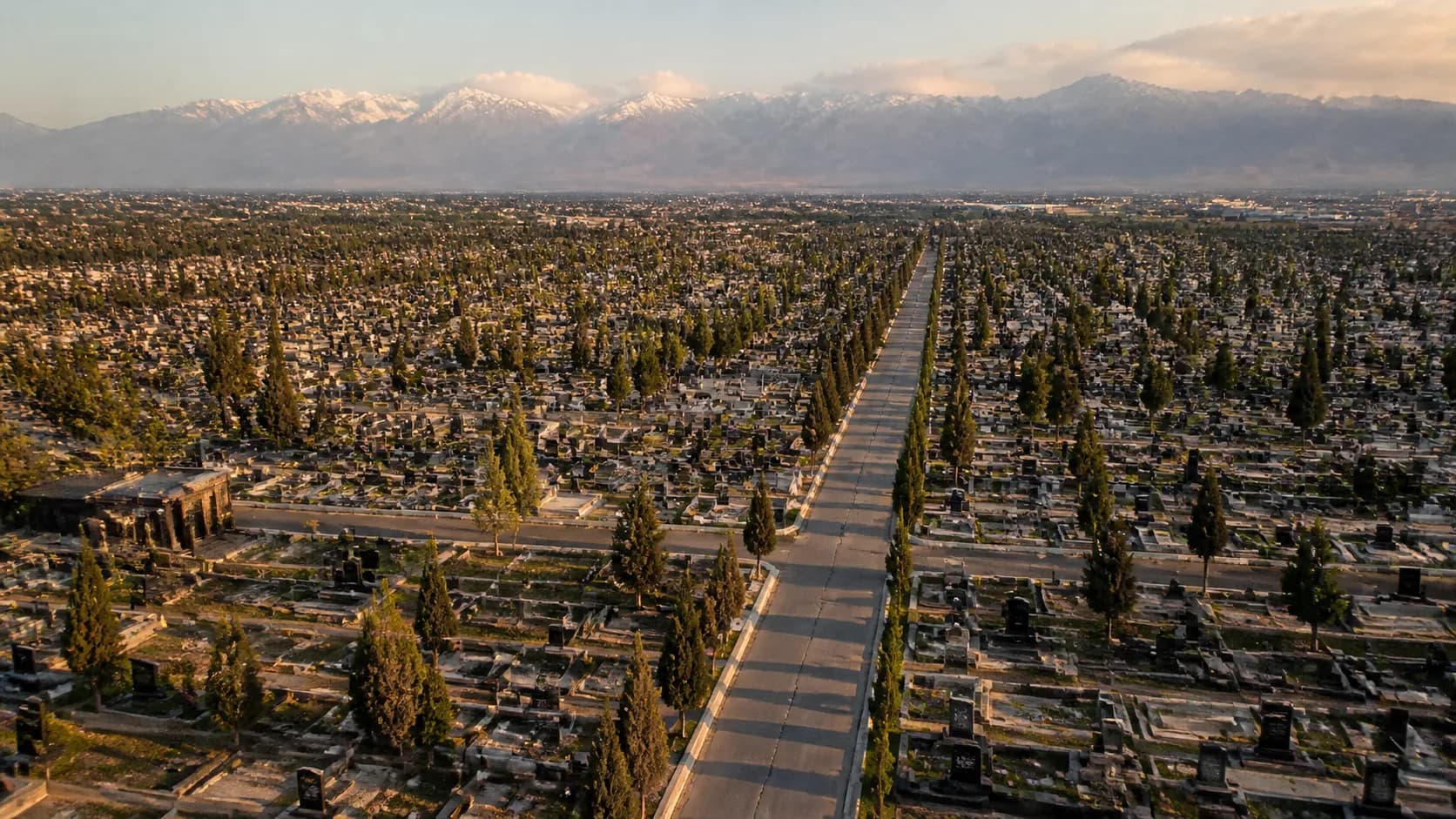
Domabad (sometimes spelled «Dombrabad») is Tashkent's largest cemetery and one of the largest in Central Asia: 165 hectares (~230 football pitches) and 450,000+ graves. Opened in the 1960s as Botkin and Chigatay ran out of space.
Location. Southeastern outskirts of Tashkent, between Kamarniso Highway and the Anhor canal. City buses 100 and 150 to the western entrance terminus. ~12 km from city centre; taxi 20–35 minutes.
Structure. Sectors numbered 1 through 50+. Sectors 1–15: late 1960s–1980s. 16–30: 1990s–2000s. 31–50: 2010s onward. Each sector has its own entry and internal drives; for any sector over 5 hectares, GPS coordinates are essential.
Multi-faith. Although the majority are Sunni Uzbek, Domabad also has Orthodox, smaller Jewish, Armenian and Korean plots — it's the city cemetery in the broadest sense, all Tashkenters welcome.
Archives. Digital from 2005 onward; pre-2005 paper journals, partially restored. Filed in Uzbek or Russian, turnaround 5–10 working days. Pre-Soviet data doesn't exist (Domabad opened later).
Why GPS is critical. On 165 hectares with 450,000 graves you can search 4–6 hours for a grave even after administration says «sector 8, row 42». Plot numbering within a sector isn't always obvious. GPS coordinates are standard with us; see the dedicated GPS spoke.
What we do at Domabad. Search with GPS coordinates (standard). Care subscriptions. Monument installation — partnership with two stonemasons near sector 10. Video confirmation (needed more often than at Botkin given the scale).
Visit notes. Major religious holidays (Eid al-Fitr, Eid al-Adha, Orthodox parental Saturdays for the Orthodox section) bring thousands of visitors simultaneously. Normal days are calm. Bring water in summer — most plots have no shade.
Frequently asked questions
Yes. As part of the Standard or Premium package: satellite map (Google or OpenStreetMap), pin on the sector, walking annotation from the nearest gate. PDF + cabinet link.