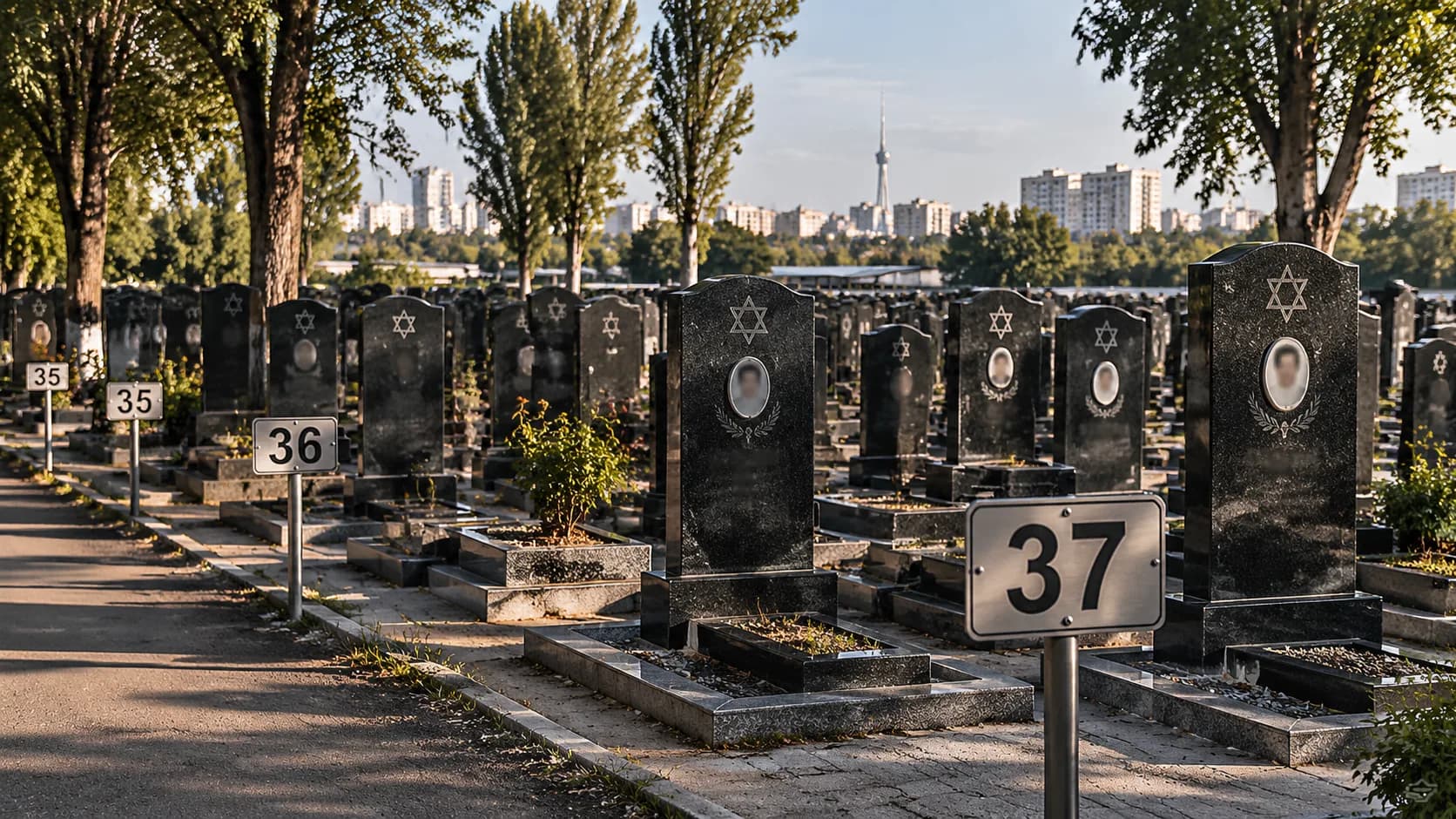
The Textile Jewish Cemetery (colloquially «European Jewish») sits in central Tashkent next to the historic Textile Factory. 16,300 burials across 8 sectors: 6 Jewish + 2 Russian, separated by an internal wall. The main Jewish cemetery of Tashkent from the 1930s to today, although for post-Soviet Bukharian families the Domabad expansion also matters.
Sectors. 1 — oldest (late 1920s), mixed Ashkenazi and early Bukharian burials. 2–4 — Soviet period, mostly Ashkenazi evacuees. 5–6 — post-Soviet (1990s onward), mostly Bukharian. 7–8 — Russian, separated by a low wall.
Access. Zulfiyaxonim Street, by the Textile Factory. City buses 7, 50 to the «Tekstilkombinat» stop. Metro: Kosmonavtlar station, then 2 km on foot or by taxi.
Archives. Paper registration book, certified by administration. Russian or Uzbek queries, 5–10 working days. Digitization partial — last 10 years in Excel. Post-Soviet case resolution ~80%; pre-Soviet ~50%.
Stone style. Soviet (sectors 2–4): grey marble or limestone, bilingual Hebrew + Russian. Post-Soviet (5–6): black Indian granite with ceramic photos and a Star of David element. Sector 1's old Ashkenazi stones: tall stone stelae with deeply carved hexagrams.
Maintenance. Partially supported by the Tashkent Jewish Federation, partially by individual families. Generally good on main paths; periphery weaker.
What we do. Search (3–5 days). Care subscriptions (synced to Hebrew calendar). Hakamat HaMatzevah — coordinated with the Tashkent Chevra Kadisha. Restoration of old Ashkenazi stelae from sector 1 — separate service with two trusted stonemasons.
Related articles in Cluster 5 (Bukharian Jewish) cover the broader Bukharian heritage and the lifecycle-of-mourning details.
Frequently asked questions
Botkin is on Botkin Street, imperial 1872 foundation, multi-faith. Textile is by the Textile Factory, Soviet-era, predominantly Jewish with two Russian sectors. Jewish surname — likely Textile; Russian — likely Botkin.