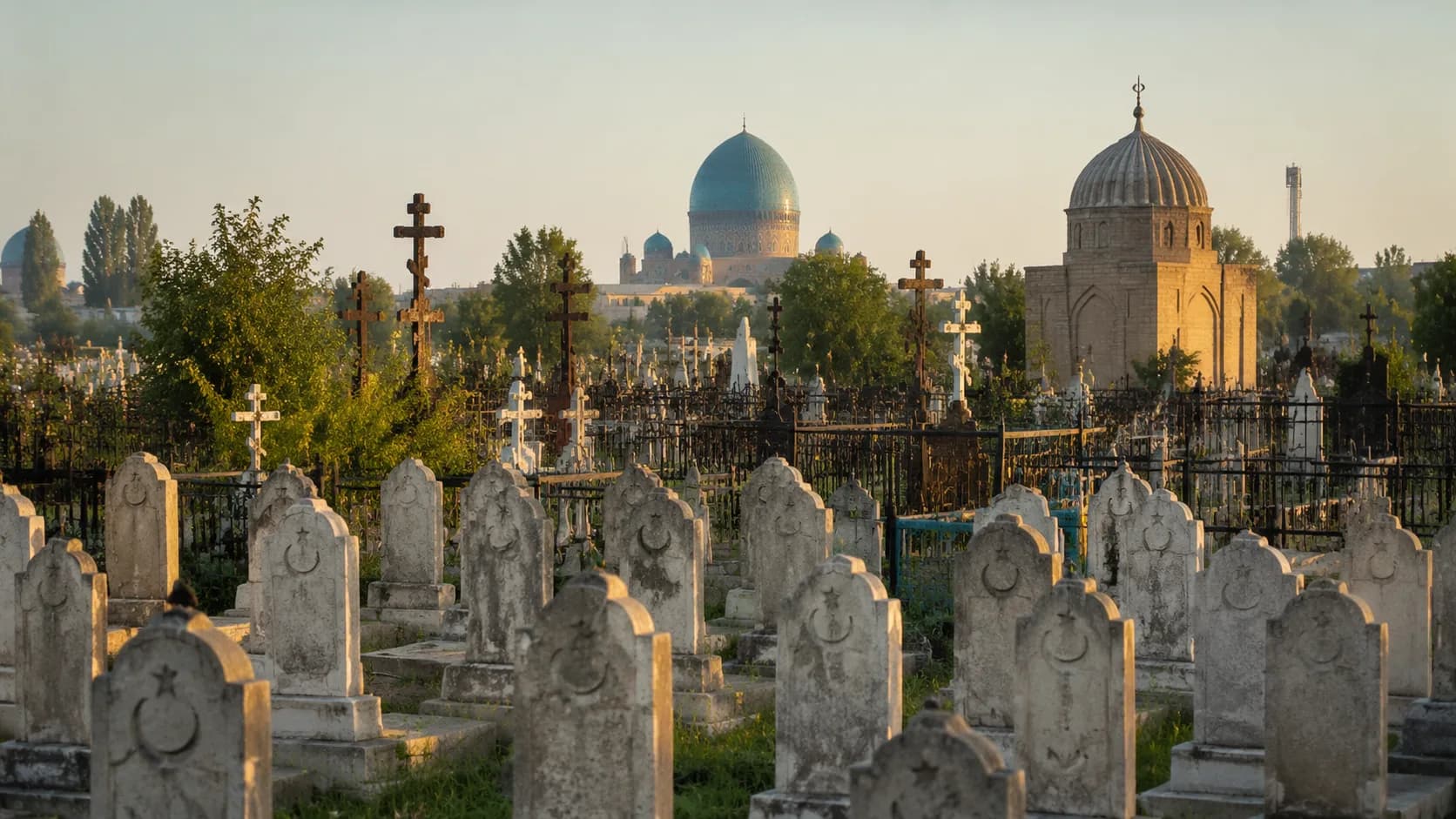
Samarkand is Uzbekistan's second city by concentration of historical memory. It has several independent cemeteries, each with its own community history. This article is an overview of the five main sites.
1. Old Jewish Cemetery (Mahalla Yahudi). At the foot of Hojum Hill, adjacent to the historic Jewish quarter. Several thousand graves. The Samarkand Jewish community is small but the cemetery is in active use; several rabbinic family plots are maintained continuously across generations. See our article on the Samarkand Jewish cemetery.
2. Shah-i-Zinda. Historic Muslim necropolis from the 11th–15th centuries with unique mausoleums. Not an active cemetery for modern burials — an architectural monument and pilgrimage site; the tomb of Qusam ibn Abbas (cousin of the Prophet) is here. Not a search site, but essential for understanding the regional Muslim ritual.
3. Modern Muslim cemetery of Samarkand. Southern outskirts. Most Uzbek Muslim burials in modern Samarkand. Burials scheduled regularly. Partially digital archive from the 2010s.
4. Russian cemetery of Samarkand. Northern part of the city, near the Alexei of Moscow church. Open from the late 19th century with the Russian Empire. Russian settlers, Soviet-era leadership, post-Soviet Russian-speaking Samarkanders. See our article on Orthodox commemoration.
5. Polish Catholic cemetery. Small, emotionally significant. See the dedicated «Polish cemetery in Samarkand» article.
6. Armenian family plots. Not a standalone cemetery — several Armenian family burials scattered across the Russian and central city cemeteries. See our article on Armenian traditions.
Search practice in Samarkand. Each cemetery has its own archive. If you don't know the cemetery, we start from the most likely by ethnicity. Search 5–10 days, 1–2 days longer than Tashkent due to multiple archive visits.
Frequently asked questions
Only if they lived before the 16th century and were a significant figure of regional Muslim history. Modern burials haven't been added since the 1500s. For 19th–20th century ancestors — the modern Muslim cemetery of Samarkand.
Grave care and grave search in Samarkand
Read next in this cluster
- The Botkin Cemetery in Tashkent: history, sectors, how to navigate itComplete guide to the Botkin Cemetery (Cemetery No. 1) — the oldest in Tashkent, founded in 1872. Sectors, transport, what to look for, who is buried there.
- Bukhara Jewish Cemetery: how to get thereQuick guide: how to access, sectors, maintenance state. The full story is in our guide to Bukharian Jewish cemeteries.
- The Polish cemetery in Samarkand: history and surviving familiesThe Polish diaspora of Samarkand: 19th-century exiles, the Anders' Army, the descendants. Where graves are found, how to maintain them, what documents matter.
Related topics
In the cemetery registry
Need help or a detailed estimate?
We're available 24/7. Leave a request — we'll call back and clarify.