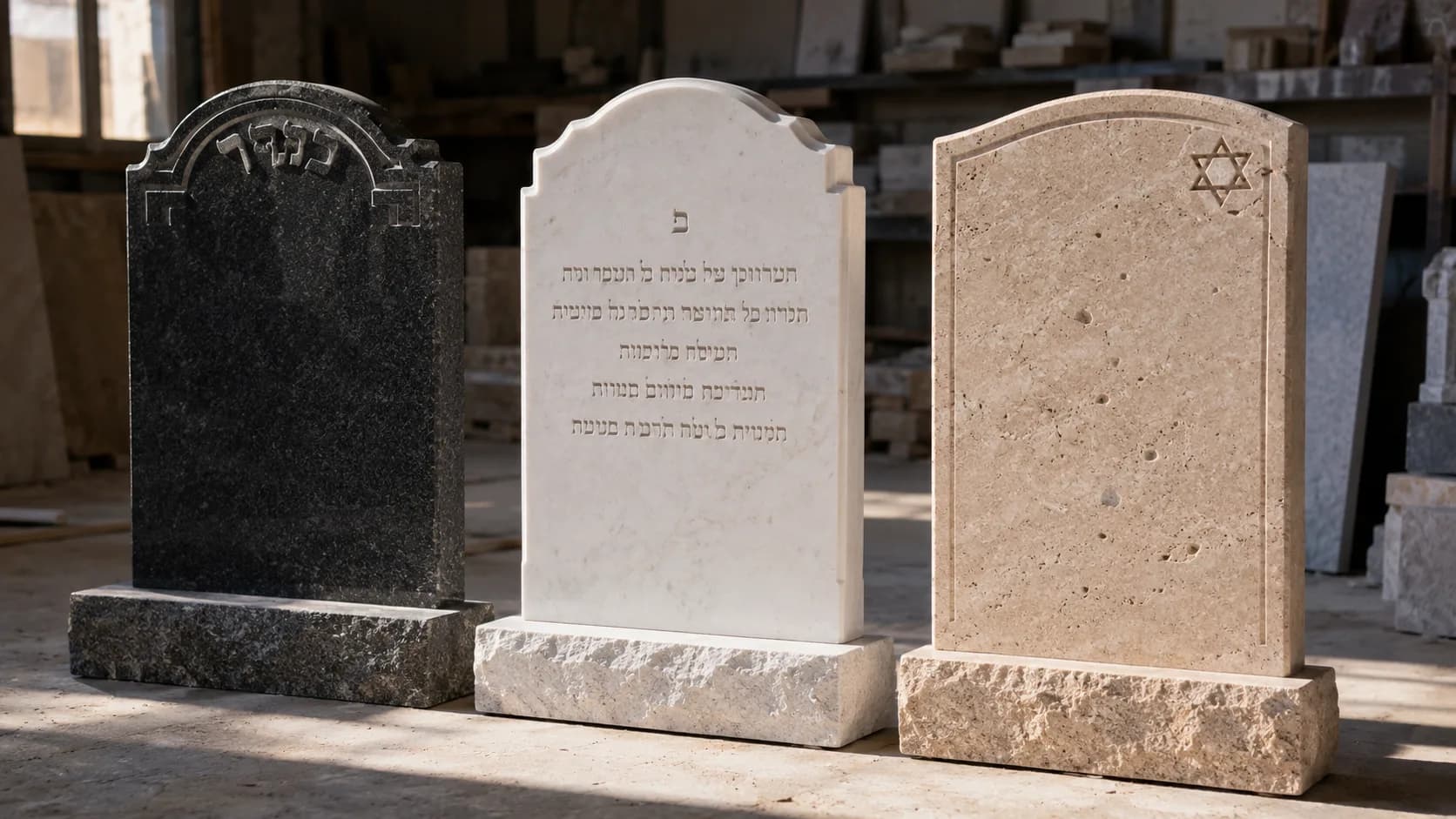
A matzevah — the Jewish gravestone — has both halakhic and aesthetic dimensions. Halakhic basics are simple: a permanent marker identifying the deceased so the grave can be visited. The aesthetic choices — material, inscription style, ornament — vary widely across communities. This article focuses on Bukharian-community conventions in Uzbekistan today.
Material. Bukharian community matzevahs are predominantly polished black granite (Absolute Black or Black Galaxy) since the 1990s. The older pre-Soviet stones are typically white limestone with deeply carved Hebrew. White marble or Kashmir White granite is the historically traditional Sephardic preference — some families maintain this for aesthetic continuity. Travertine is occasionally used but durability concerns are common.
Shape. Bukharian style favours a rectangular shape with rounded or arched top — distinct from Ashkenazi straight-edge stelae. Some larger family matzevahs add ornamental columns or a low decorative cornice.
Inscription content (top to bottom).
1. The phrase «פ"נ» (po nikbar — «here is buried») or «פ"ט» (po tamun) at the very top.
2. The deceased's Hebrew name with patronymic (e.g., Yosef ben Yaakov) and the title «ר\'» (Reb) for laypeople or rabbinical title for rabbis.
3. The date of death in the Hebrew calendar.
4. The deceased's birth-place city or country.
5. Brief epitaph (1–3 lines) — often a verse from Psalms or a personal phrase.
6. The acronym «תנצב"ה» (tehi nishmato/nishmatah tzrura bitzror hahaim — «may their soul be bound up in the bond of life») at the bottom.
Bilingual layout. Modern Bukharian matzevahs in Uzbekistan typically have Hebrew on the upper portion and Russian on the lower — same person, two languages, two scripts. Sometimes a third line in Bukhori or in English for diaspora families. The Hebrew is laser-engraved or sandblasted; the Russian sometimes uses bronze letters for visual hierarchy.
Ornament. Star of David at the top is universal in modern matzevahs. Bukharian-specific ornament — a small olive branch or palm motif near the patronymic. Some families add a cypress or a menorah element. Floral and animal imagery is generally avoided by halakhic norm.
Sizes. Standard matzevah 100–120 cm tall × 50–60 cm wide × 8–10 cm thick. The base (tumba) is 60–80 × 20–25 × 15–20 cm. For Hakamat HaMatzevah ceremony complexity, see the dedicated C5 spoke article.