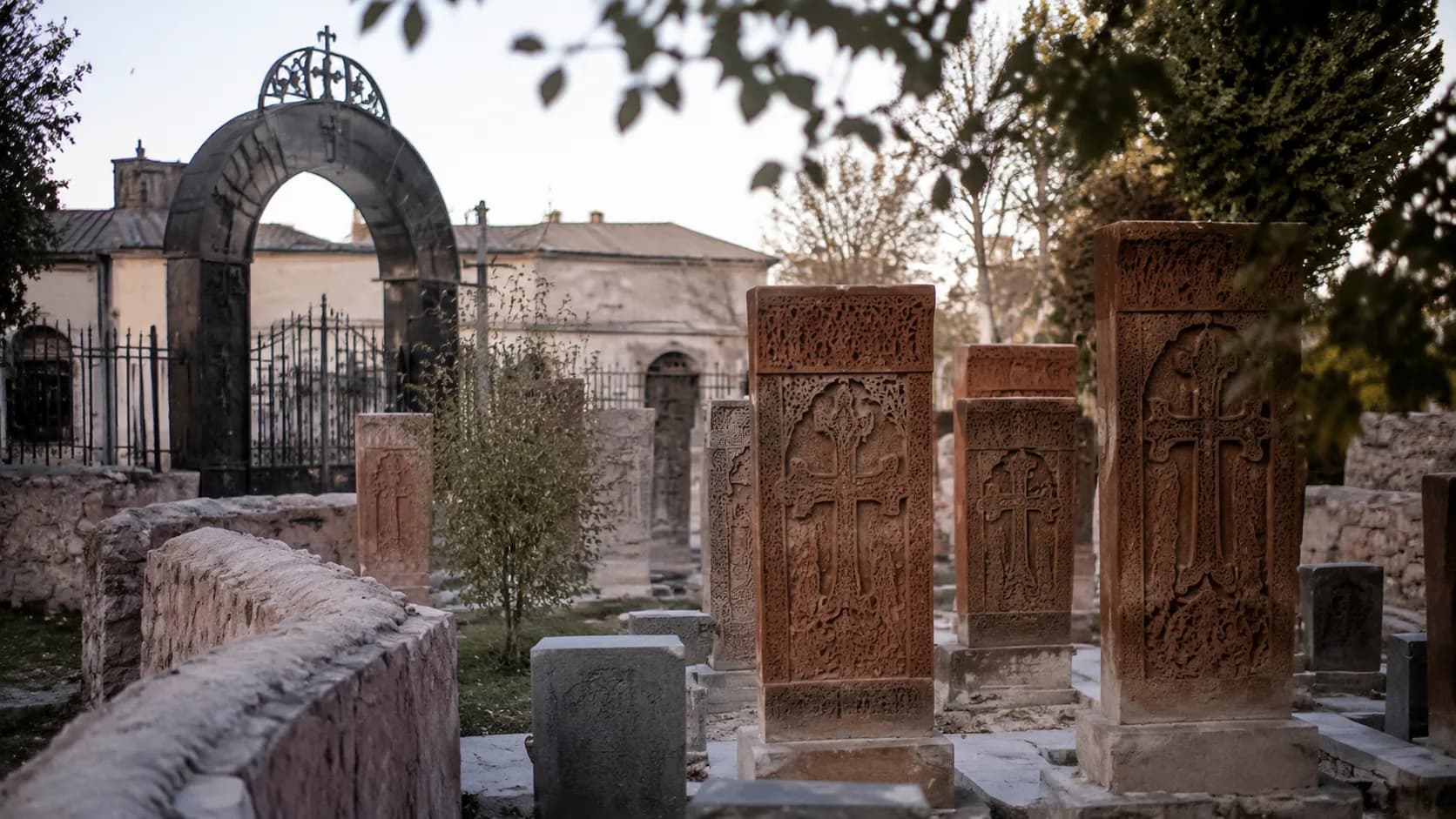
The Armenian section in Tashkent is small but historically significant. Part of the Armenian diaspora arrived in the Russian Empire in the 19th century as traders and craftsmen. A large wave came after the 1915 Genocide: refugees from the Ottoman Empire moved through Russia to Central Asia. A third layer is Soviet-era Armenian families from the 1920s–1980s. Modern Tashkent's Armenian community is about 2,000–3,000.
Location. The Armenian sector is on the grounds of one of the old Tashkent cemeteries (by Soviet-era agreement with city authorities), near Yunusabad Street. ~200–300 burials. Separated by a low wall from the adjacent Orthodox and city sections.
Style. Characteristic khachkars — carved stone crosses with floral ornament. Many post-Soviet stones are granite stelae with bilingual Armenian-Russian inscriptions. Red carnations are the main Armenian memorial flower.
Transport. City buses and marshrutkas to Yunusabad stop. 15–20 minutes from Tashkent centre.
Archive. Small but well-kept — the Armenian Apostolic Church in Tashkent (next to the section) maintains records; for an Armenian diaspora family, a direct church query usually suffices. ~85–90% search success.
Care state. Good on main paths. Actively maintained by the Tashkent Armenian Church and small community. On anniversaries and April 24 (Genocide Memorial Day) there's a major flower laying.
What we do. Search (3–7 days). Subscriptions 4–6/year — typical for Armenian diaspora (7-day, 40-day, anniversary, April 24). Coordination with the Armenian Apostolic Church for hokehangist services. Restoration of old khachkars — specialty service with three Armenian carvers in Tashkent.
Frequently asked questions
Yes. The Church of St. Minas is active; Sunday services. Accepts hokehangist and memorial service requests for diaspora families.