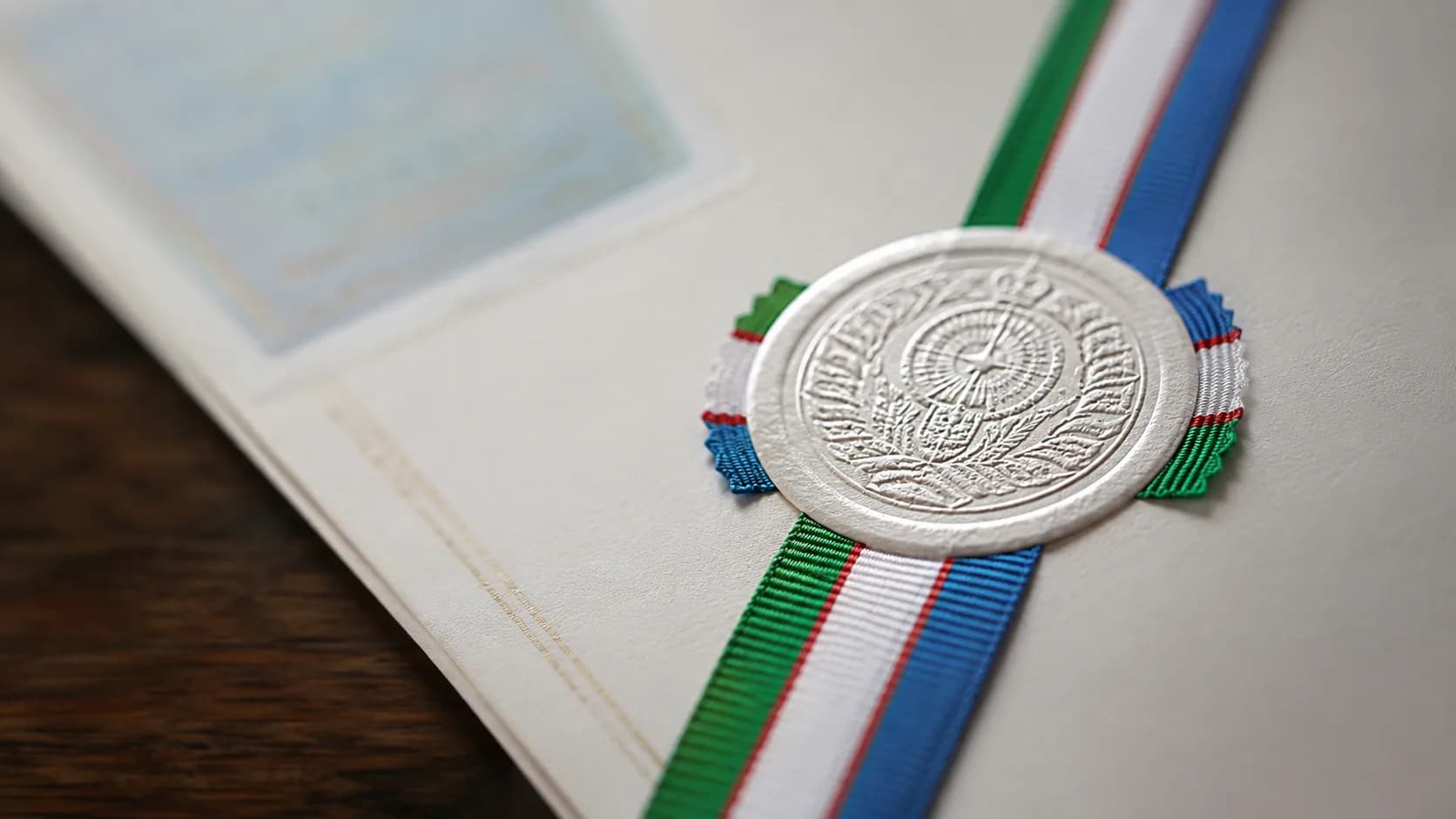
The Hague Apostille Convention has applied to Uzbekistan since 15 April 2012. Before that, every Uzbek document used abroad needed full consular legalization — a process that could take months. Today a single apostille is enough in most Convention countries, including the US, Canada, the UK, France, Israel, Australia and most of the EU. The exceptions are Germany, Austria and Greece: they objected to Uzbekistan’s accession in February 2012, so an Uzbek apostille is not valid there (HCCH). Belgium withdrew its objection; the Convention has applied between Belgium and Uzbekistan since 11 June 2025.
Where the apostille is issued. For civil-status documents such as a death certificate, the apostille is issued by the Uzbek justice authorities. It can be ordered online on my.gov.uz (service 543) or at a public services centre (buxgalter.uz, my.gov.uz).
Process. Sign in to my.gov.uz with OneID, choose the authority that issued the document (the civil registry) and submit the application. The standard term is 2 working days, up to 10 if additional checks are needed (buxgalter.uz).
Cost. The state fee is 0.18 of the base calculation value (BCV) — 74,160 sum as of 20.10.2025; the BCV is indexed, so check the portal (buxgalter.uz). A certified translation is paid separately.
Order matters. Critical sequence: get the death certificate first, then apostille, THEN translate. Apostille is placed on the original Russian/Uzbek document; translation follows. Some receiving countries require apostille on the translation too — this is a second apostille, applied after the translation is sworn.
Recognition. Recognised in: the US, Canada, the UK, the EU except Germany, Austria and Greece, Israel, Australia, New Zealand, South Korea, Japan and other Convention countries; China has applied the Convention since 7 November 2023. NOT recognised in Germany, Austria and Greece or in countries outside the Convention — there, consular legalization or a document check applies. For Germany see our guide on document verification.
What we do. Full chain: collect the original from ZAGS, get the apostille from the Ministry of Justice, arrange the sworn translation, courier the apostilled bundle to your country. The coordinator quotes the price of the apostille step; translation is paid separately. Diaspora families typically order this as part of our complete repatriation or estate-administration service.
Frequently asked questions
Yes. Duplicates have the same legal force as originals; the apostille works on either.
No. Germany, Austria and Greece objected to Uzbekistan’s accession in 2012. In Germany the receiving authority can instead order a document verification (Urkundenüberprüfung) through the German embassy in Tashkent.
Read next in this cluster
- Uzbek death certificate: where and how to obtain oneComplete guide to obtaining a death certificate in Uzbekistan: ZAGS office, applicant documents, timelines, fees, considerations for families abroad.
- Notarization vs apostille: when each is required for Uzbek documentsTwo different legalization mechanisms with different uses. Notarization confirms signatures; apostille confirms the official-source authority. When to use which.
- Uzbek documents in Germany: no apostille, what nowAn Uzbek apostille is not valid in Germany. How the German embassy in Tashkent verifies documents, what it costs and what German authorities need.
Related topics
Need help or a detailed estimate?
We're available 24/7. Leave a request — we'll call back and clarify.