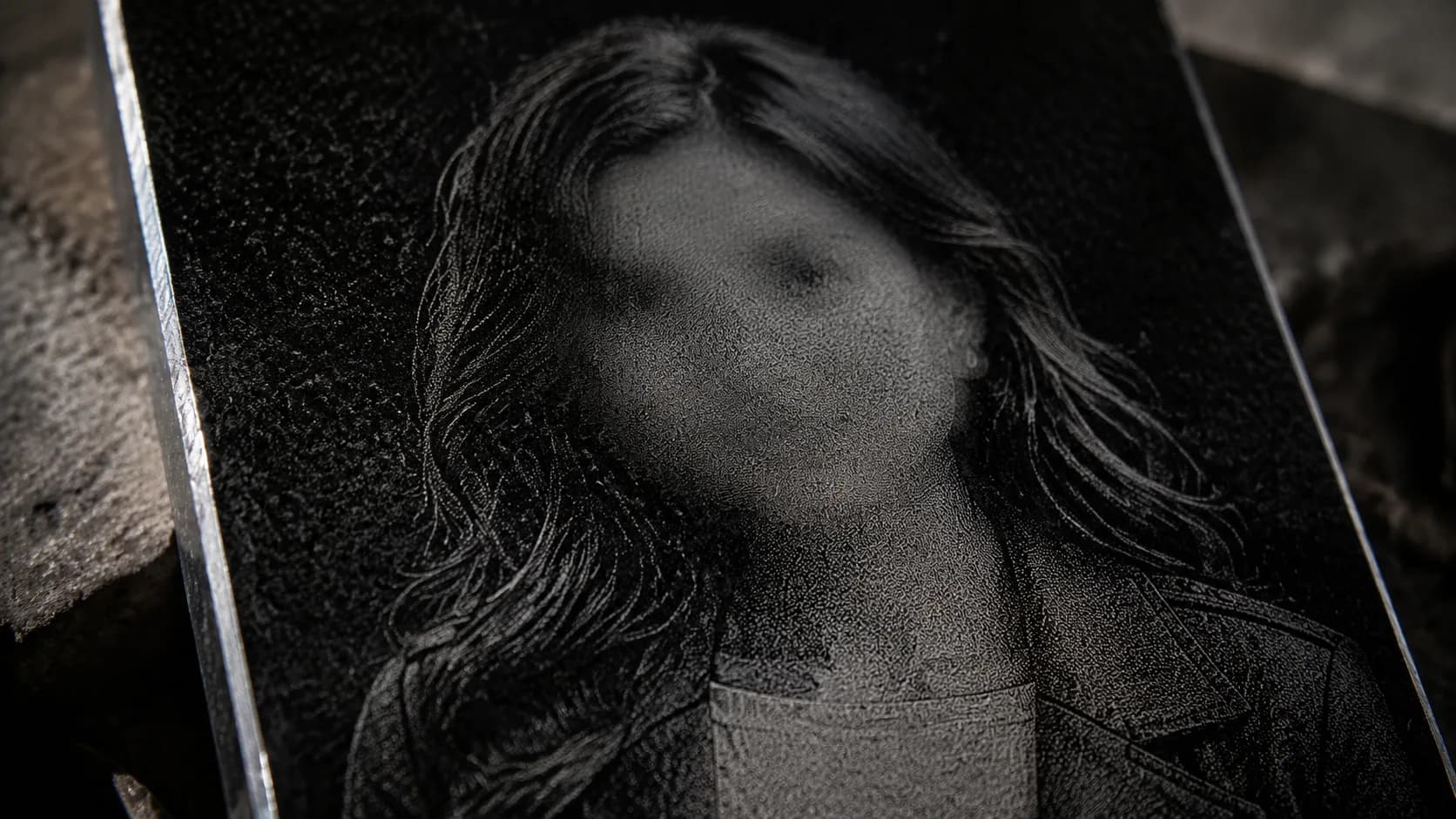
HD laser portrait engraving has been the most popular image technique on Uzbek monuments in the last 10 years. This article: how it works and what's important when ordering.
Technology. An industrial laser with controlled power «burns» micro-dots of varying depth and density into the polished granite. Darker tone areas — denser dots. The result is a halftone image visible thanks to contrast with the mirror surface. Each dot is 0.1–0.2 mm; a 12×18 cm portrait has 1.5–2 million dots.
What's needed from the photo. High resolution (≥1500×2000 pixels original, not upscaled). Good face lighting (not backlit, not flat). Sharp focus on eyes. Neutral background preferred (we can remove background). Colour or B&W — engraving is halftone either way.
Bad source photos. Dark/under-exposed. Complex graphic or ornamental background. Low resolution (pre-2016 smartphones). Shadow on face. Bright sunlight blow-out on face.
Durability. Laser engraving doesn't weather (it's micro-relief of the stone itself). Lasts as long as the stone — 100+ years outdoors. Only condition — granite must stay polished; surface fogging masks the engraving.
Versus ceramic portrait. Ceramic — different format: colour, on a separate ceramic plate fixed to the stone. Ceramic pros: colour, more «alive» face. Ceramic cons: irrecoverable if chipped, colour fades 20–30 years, cracks possible around mounting in cold winters. Laser pros: lasts with the stone, doesn't fall off.
Portrait sizes. Standard: 12×18, 18×24, 24×30 cm. For a main 100×60 stela — usually 18×24 (proportional). For large memorial complexes — 24×30. For small markers — 12×18.
Prices. 12×18: $80–150. 18×24: $120–220. 24×30: $200–350. Includes: laser work, digital photo processing (enhancement, background removal), 1 revision. Extra revisions $30–50 each.
Frequently asked questions
Technically yes — the master brings mobile equipment. Cost 30–50% higher, and the stone needs to be removed for 2–3 hours. Quality same as in workshop.